Deprecated: Creation of dynamic property Disable_Comments::$is_CLI is deprecated in D:\www\pep\blog\wp-content\plugins\disable-comments\disable-comments.php on line 59

Deprecated: Creation of dynamic property Disable_Comments::$sitewide_settings is deprecated in D:\www\pep\blog\wp-content\plugins\disable-comments\disable-comments.php on line 61

Deprecated: Creation of dynamic property Permalink_Manager_Class::$permalink_manager_uris is deprecated in D:\www\pep\blog\wp-content\plugins\permalink-manager\permalink-manager.php on line 137

Deprecated: Creation of dynamic property Permalink_Manager_Class::$permalink_manager_permastructs is deprecated in D:\www\pep\blog\wp-content\plugins\permalink-manager\permalink-manager.php on line 138

Deprecated: Creation of dynamic property Permalink_Manager_Class::$permalink_manager_redirects is deprecated in D:\www\pep\blog\wp-content\plugins\permalink-manager\permalink-manager.php on line 139

Deprecated: Creation of dynamic property Permalink_Manager_Class::$permalink_manager_external_redirects is deprecated in D:\www\pep\blog\wp-content\plugins\permalink-manager\permalink-manager.php on line 140

Deprecated: Creation of dynamic property Permalink_Manager_Class::$permalink_manager_alerts is deprecated in D:\www\pep\blog\wp-content\plugins\permalink-manager\permalink-manager.php on line 145

Deprecated: Creation of dynamic property SEOPress\Actions\Admin\Importer\AIO::$tagsAIO is deprecated in D:\www\pep\blog\wp-content\plugins\wp-seopress\src\Actions\Admin\Importer\AIO.php on line 12

Deprecated: Creation of dynamic property SEOPress\Actions\Admin\Importer\RankMath::$tagsRankMath is deprecated in D:\www\pep\blog\wp-content\plugins\wp-seopress\src\Actions\Admin\Importer\RankMath.php on line 12

Deprecated: Creation of dynamic property SEOPress\Actions\Front\Metas\DescriptionMeta::$tagsToStringService is deprecated in D:\www\pep\blog\wp-content\plugins\wp-seopress\src\Actions\Front\Metas\DescriptionMeta.php on line 11

Deprecated: Creation of dynamic property SEOPress\Actions\Front\Metas\TitleMeta::$tagsToStringService is deprecated in D:\www\pep\blog\wp-content\plugins\wp-seopress\src\Actions\Front\Metas\TitleMeta.php on line 11

Deprecated: Creation of dynamic property DisableComments_Plugin_Tracker::$disabled_wp_cron is deprecated in D:\www\pep\blog\wp-content\plugins\disable-comments\includes\class-plugin-usage-tracker.php on line 69

Deprecated: Creation of dynamic property DisableComments_Plugin_Tracker::$enable_self_cron is deprecated in D:\www\pep\blog\wp-content\plugins\disable-comments\includes\class-plugin-usage-tracker.php on line 70

Deprecated: Creation of dynamic property DisableComments_Plugin_Tracker::$require_optin is deprecated in D:\www\pep\blog\wp-content\plugins\disable-comments\includes\class-plugin-usage-tracker.php on line 74

Deprecated: Creation of dynamic property DisableComments_Plugin_Tracker::$include_goodbye_form is deprecated in D:\www\pep\blog\wp-content\plugins\disable-comments\includes\class-plugin-usage-tracker.php on line 75

Deprecated: Creation of dynamic property DisableComments_Plugin_Tracker::$marketing is deprecated in D:\www\pep\blog\wp-content\plugins\disable-comments\includes\class-plugin-usage-tracker.php on line 76

Deprecated: Creation of dynamic property DisableComments_Plugin_Tracker::$options is deprecated in D:\www\pep\blog\wp-content\plugins\disable-comments\includes\class-plugin-usage-tracker.php on line 77

Deprecated: Creation of dynamic property DisableComments_Plugin_Tracker::$item_id is deprecated in D:\www\pep\blog\wp-content\plugins\disable-comments\includes\class-plugin-usage-tracker.php on line 78

Deprecated: Creation of dynamic property Disable_Comments::$tracker is deprecated in D:\www\pep\blog\wp-content\plugins\disable-comments\disable-comments.php on line 149

Deprecated: Creation of dynamic property DisableComments_Plugin_Tracker::$notice_options is deprecated in D:\www\pep\blog\wp-content\plugins\disable-comments\includes\class-plugin-usage-tracker.php on line 657

Warning: Cannot modify header information - headers already sent by (output started at D:\www\pep\blog\wp-content\plugins\disable-comments\includes\class-plugin-usage-tracker.php:78) in D:\www\pep\blog\wp-includes\feed-rss2.php on line 8
amino acids – Creative Peptides Blog https://www.creative-peptides.com/blog Thu, 01 Aug 2019 08:39:14 +0000 en-US hourly 1 https://wordpress.org/?v=6.1.1 Peptides can be synthesized without amino acids https://www.creative-peptides.com/blog/peptides-can-be-synthesized-without-amino-acids/ Thu, 01 Aug 2019 08:39:14 +0000 http://www.creative-peptides.com/blog/?p=582 Amide bond formation is one of the most important reactions in chemistry and biology, but there is no chemical way to achieve α-peptide ligation in water without using all 20 amino acids. The general genetic code determines that the biological role of peptides predates the last common ancestor of life, and peptides play an important role in the origin of life. The important role of sulfur in the citric acid cycle, non-ribosomal peptide synthesis, and polyketone biosynthesis indicates that thioester-dependent peptide-binding occurs earlier than RNA-dependent protein synthesis in the process of life evolution. However, no one has confirmed the robust mechanism of aminoacyl thioester formation.

In a new study, researchers from University College London, UK, reported a chemoselective, high-yield α-amino nitrile link. This α-amino nitrile connection only uses the molecules that may exist before the origin of life-hydrogen sulfide, thioacetate, ferricyanide or cyanoacetylene to produce α-peptides in water. The results of the study, entitled “Peptide ligation by chemoselective aminonitrile coupling in the water”, were published online in the journal Nature on July 10, 2019.
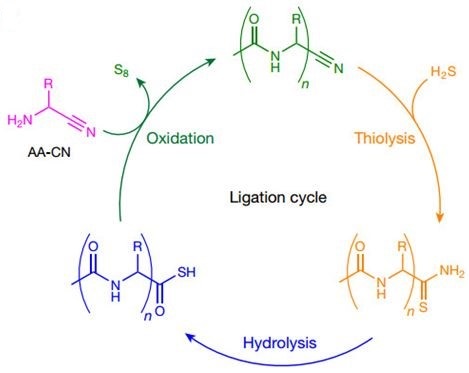
“Peptides are long chains of amino acids that are a key element of all life on Earth,” explained Professor Matthew Powner of University College London, who led the study, “they can further form proteins. In charge of the biological process. “Although scientists have clarified the relationship between amino acids, peptides, and proteins, a key question about the origin of life has never been solved: the synthesis of peptides from amino acids requires the involvement of enzymes; The enzyme that dominates this step is a protein; but to synthesize this protein, we need amino acids to synthesize peptides first. “This is a classic ‘chicken first or egg first’ question.” Professor Powner added.

Previously, many scientists have been studying how amino acids spontaneously form peptides. However, the conditions required for the reaction are extremely harsh and difficult to achieve. In the study, the team focused on aminonitriles, the precursor of amino acids. They found that these molecules are inherently reactive and can directly form peptides without first converting them into amino acids. In other words, the researchers have found a way to synthesize peptides without the need for amino acids.

α-amino nitrile coupling has high selectivity for α-amino nitrile coupling, so there is no need for the existence of the amino acids of these 20 proteins. Two basic characteristics make the peptide binding in water: the reactivity of α-amino nitrile and pKaH make them connect under neutral pH. N-acylation keeps the peptide product produced by this connection stable and activates the peptide precursor, thus achieving biologically simulated N-C peptide binding.

This model unifies the synthesis of amino nitrile and biological α-peptide before the origin of life, and points out that the shorter N-acyl peptide nitrile is a potentially feasible substrate in the process of early evolution.

References

  1. Canavelli, P., Islam, S., & Powner, M. W. (2019). Peptide ligation by chemoselective aminonitrile coupling in water. Nature.
]]>
Amino Acids Will Play the Role into Full Play Soon https://www.creative-peptides.com/blog/amino-acids-will-play-the-role-into-full-play-soon/ Thu, 29 Oct 2015 05:01:38 +0000 http://www.creative-peptides.com/blog/?p=113 In 1806, French chemists Louis-Nicolas Vauquelin and Pierre Jean Robiquet isolated a compound in asparagus that was subsequently named asparagine, and then the first amino acid was discovered. Generally, amino acids have already been regarded as biologically important organic compounds that contain amine and carboxylic acid functional groups. Specifically, they are usually along with a side-chain specific to each amino acid.

amino acidsActually, with the advance of modern biotechnology, a wide range of chemical substances have been discovered for the further development of modern clinical applications, such as peptides, amino acids, antibiotics, and so on. While as for amino acids, the key elements are carbon, hydrogen, oxygen, and nitrogen. However, there are some other elements can be found in the side-chains. In terms of the rapid development of amino acids, nearly five hundred amino acids have been known for people, which can be divided into wide categories based on different functions. For example, they can be classified in terms of the location of core structural groups, they can also be classified for the relation with polarity or side-chain type.

Anyway, massive definitions can be used in the process of classification. Amino acids have developed an important role in recent years, namely comprising the second-largest component of human cells, as well as some certain tissues. On the other hand, they also help the process of neurotransmittertransport and biosynthesis to a large degree. Since amino acids are so important for people, they have been stressed a lot, but related concerns are increasing now because of their particular functions in modern technology. They can be helpful in assisting researchers discover more available biotechnological products, such as synthesis and phosphorylation. In addition, amino acids have played critical non-protein roles within the body as well. Taking the human brain as an example, the standard amino acid glycine is used in red blood cells, and the non-standard carnitine is used in lipid transport.

Considering their biological significance, amino acids are important in nutrition. They will be commonly used in nutritional supplements, fertilizers, and food technology in the future. Industrial uses include the production of drugs, biodegradable plastics, and chiral catalysts can also be the applicable areas. Maybe a new era for amino acids is upcoming.

]]>