Deprecated: Creation of dynamic property Disable_Comments::$is_CLI is deprecated in D:\www\pep\blog\wp-content\plugins\disable-comments\disable-comments.php on line 59

Deprecated: Creation of dynamic property Disable_Comments::$sitewide_settings is deprecated in D:\www\pep\blog\wp-content\plugins\disable-comments\disable-comments.php on line 61

Deprecated: Creation of dynamic property Permalink_Manager_Class::$permalink_manager_uris is deprecated in D:\www\pep\blog\wp-content\plugins\permalink-manager\permalink-manager.php on line 137

Deprecated: Creation of dynamic property Permalink_Manager_Class::$permalink_manager_permastructs is deprecated in D:\www\pep\blog\wp-content\plugins\permalink-manager\permalink-manager.php on line 138

Deprecated: Creation of dynamic property Permalink_Manager_Class::$permalink_manager_redirects is deprecated in D:\www\pep\blog\wp-content\plugins\permalink-manager\permalink-manager.php on line 139

Deprecated: Creation of dynamic property Permalink_Manager_Class::$permalink_manager_external_redirects is deprecated in D:\www\pep\blog\wp-content\plugins\permalink-manager\permalink-manager.php on line 140

Deprecated: Creation of dynamic property Permalink_Manager_Class::$permalink_manager_alerts is deprecated in D:\www\pep\blog\wp-content\plugins\permalink-manager\permalink-manager.php on line 145

Deprecated: Creation of dynamic property SEOPress\Actions\Admin\Importer\AIO::$tagsAIO is deprecated in D:\www\pep\blog\wp-content\plugins\wp-seopress\src\Actions\Admin\Importer\AIO.php on line 12

Deprecated: Creation of dynamic property SEOPress\Actions\Admin\Importer\RankMath::$tagsRankMath is deprecated in D:\www\pep\blog\wp-content\plugins\wp-seopress\src\Actions\Admin\Importer\RankMath.php on line 12

Deprecated: Creation of dynamic property SEOPress\Actions\Front\Metas\DescriptionMeta::$tagsToStringService is deprecated in D:\www\pep\blog\wp-content\plugins\wp-seopress\src\Actions\Front\Metas\DescriptionMeta.php on line 11

Deprecated: Creation of dynamic property SEOPress\Actions\Front\Metas\TitleMeta::$tagsToStringService is deprecated in D:\www\pep\blog\wp-content\plugins\wp-seopress\src\Actions\Front\Metas\TitleMeta.php on line 11

Deprecated: Creation of dynamic property DisableComments_Plugin_Tracker::$disabled_wp_cron is deprecated in D:\www\pep\blog\wp-content\plugins\disable-comments\includes\class-plugin-usage-tracker.php on line 69

Deprecated: Creation of dynamic property DisableComments_Plugin_Tracker::$enable_self_cron is deprecated in D:\www\pep\blog\wp-content\plugins\disable-comments\includes\class-plugin-usage-tracker.php on line 70

Deprecated: Creation of dynamic property DisableComments_Plugin_Tracker::$require_optin is deprecated in D:\www\pep\blog\wp-content\plugins\disable-comments\includes\class-plugin-usage-tracker.php on line 74

Deprecated: Creation of dynamic property DisableComments_Plugin_Tracker::$include_goodbye_form is deprecated in D:\www\pep\blog\wp-content\plugins\disable-comments\includes\class-plugin-usage-tracker.php on line 75

Deprecated: Creation of dynamic property DisableComments_Plugin_Tracker::$marketing is deprecated in D:\www\pep\blog\wp-content\plugins\disable-comments\includes\class-plugin-usage-tracker.php on line 76

Deprecated: Creation of dynamic property DisableComments_Plugin_Tracker::$options is deprecated in D:\www\pep\blog\wp-content\plugins\disable-comments\includes\class-plugin-usage-tracker.php on line 77

Deprecated: Creation of dynamic property DisableComments_Plugin_Tracker::$item_id is deprecated in D:\www\pep\blog\wp-content\plugins\disable-comments\includes\class-plugin-usage-tracker.php on line 78

Deprecated: Creation of dynamic property Disable_Comments::$tracker is deprecated in D:\www\pep\blog\wp-content\plugins\disable-comments\disable-comments.php on line 149

Deprecated: Creation of dynamic property DisableComments_Plugin_Tracker::$notice_options is deprecated in D:\www\pep\blog\wp-content\plugins\disable-comments\includes\class-plugin-usage-tracker.php on line 657

Warning: Cannot modify header information - headers already sent by (output started at D:\www\pep\blog\wp-content\plugins\disable-comments\includes\class-plugin-usage-tracker.php:78) in D:\www\pep\blog\wp-includes\feed-rss2.php on line 8
glioma – Creative Peptides Blog https://www.creative-peptides.com/blog Wed, 03 Jun 2020 07:31:06 +0000 en-US hourly 1 https://wordpress.org/?v=6.1.1 Study proposes a new strategy to intervene glutathione metabolism in the treatment of glioma https://www.creative-peptides.com/blog/study-proposes-a-new-strategy-to-intervene-glutathione-metabolism-in-the-treatment-of-glioma/ Wed, 03 Jun 2020 07:31:06 +0000 http://www.creative-peptides.com/blog/?p=665 Recently, Xu Guowang, a researcher of the Biomolecular High-resolution Separation Analysis and Metabolomics Research Group of the Dalian Institute of Chemical Physics, Chinese Academy of Sciences, and the National Cancer Institute (NCI) researcher Yang Chunzhang, have made new progress in the treatment of isocitrate dehydrogenase 1 (IDH1) mutant glioma, revealing the importance of the glutathione (GSH) metabolic pathway regulated by Nrf2, and a new strategy for the intervention of glutathione metabolism in the treatment of gliomas is proposed.

Glioma is the most common primary central nervous system tumor. Although the incidence is low, the mortality rate is extremely high. Isocitrate dehydrogenase I (IDH1) mutations are highly likely in glioma patients. In patients with low-grade gliomas and patients with secondary glioblastoma, the proportion of IDH1 mutations can reach about 70%, but there is currently no selective treatment for IDH1 mutant gliomas. IDH1 mutations cause significant changes in enzymatic reactions, catalyzing the large-scale conversion of α-ketoglutarate (2-KG) to 2-hydroxyglutarate (2-HG), and cause significant changes in the cell’s metabolic system. IDH1 mutations cause significant metabolic changes, suggesting that tumor cells rely on specific metabolic pathways to complete cell biological processes. Drug interventions targeting the changing metabolic pathways in IDH1 mutations may suggest new treatment options for gliomas.

The study found that after IDH1 mutation, it will catalyze the massive conversion of 2-KG to tumor metabolite 2-HG, while consuming reduced NADPH. NADPH has the effect of eliminating reactive oxygen species (ROS) in the body, and IDH1 mutation weakens its ability to eliminate ROS. In order to maintain the steady state of ROS, other antioxidant pathways will become more active after IDH1 mutation. In vitro studies have found that in IDH1 mutant glioma stem cells (TS603), the expression of genes related to ROS clearance is overall upregulated, and the gene that regulates glutathione synthesis, SLC7A11, is most upregulated. In addition, inhibiting the expression of SLC7A11 gene will affect the synthesis of glutathione, thereby causing the apoptosis of IDH1 mutant glioma cells.

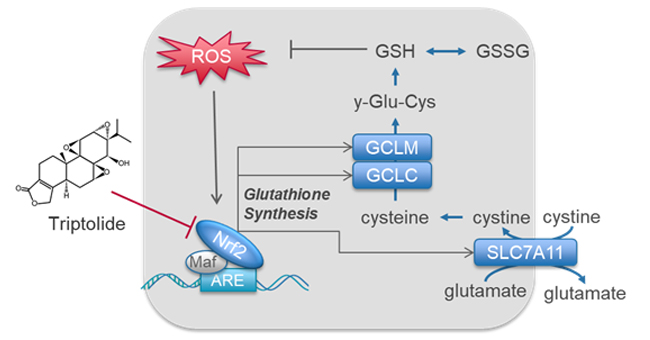
Glutathione anabolism is regulated by the transcription factor Nrf2 and is an important antioxidant metabolic pathway. Inhibiting the transcriptional activity of Nrf2 can reduce glutathione synthesis. Triptolide is a diterpene epoxy compound extracted from Tripterygium wilfordii, which is a highly effective Nrf2 inhibitor. In vivo and in vitro models, it was found that in the IDH1 mutant glioma cells intervened by triptolide, the transcriptional activity of Nrf2 was suppressed, and the expression of genes related to glutathione anabolic metabolism (GCLC, GCLM, and SLC7A11) was significantly down-regulated. The glutathione synthesis pathway is destroyed, and the oxidative damage in the cells increases, which leads to apoptosis and inhibits tumor growth.

The research team found that in IDH1 mutant cancer cells, the glutathione anabolic pathway is very active. Glutathione anabolism is regulated by Nrf2 transcription factor and is an important antioxidant metabolic pathway. In vitro studies have found that inhibiting the transcriptional activity of Nrf2 can reduce the synthesis of glutathione, thereby causing the apoptosis of IDH1 mutant cancer cells. Based on this finding, the research team proposed a new strategy for inhibiting the glutathione metabolic pathway to treat IDH1 mutant glioma.

Triptolide is a diterpene epoxy compound extracted from Tripterygium wilfordii, which is a highly effective Nrf2 inhibitor. In vitro and in vivo models, it was found that in the IDH1 mutant glioma cells intervened by triptolide, the transcriptional activity of Nrf2 was suppressed, and the expressions of GCLC, GCLM and SLC7A11 were down-regulated, thereby disrupting the metabolism of glutathione. The increased oxidative damage leads to apoptosis. This study illustrates the importance of inhibiting the glutathione metabolic pathway regulated by Nrf2 for tumor therapy, and at the same time provides a new idea for the treatment of malignant tumors with IDH1 mutations.

IDH1 mutations are common genetic abnormalities in human malignancies. In addition to gliomas, they are also very common in acute myeloid leukemia, cholangiocarcinoma, and chondrosarcoma. This study illustrates the importance of inhibiting the glutathione metabolic pathway regulated by Nrf2 for tumor therapy, and at the same time provides a new idea for the treatment of malignant tumors with IDH1 mutations.

References:

  1. Triptolide suppresses IDH1-mutated malignancy via Nrf2-driven glutathione metabolism. Yu D, Liu Y, Zhou Y, Ruiz-Rodado V, Larion M, Xu G, Yang C.Proc Natl Acad Sci U S A. . In Press: 2020. [ Journal Article]
]]>