How to improve efficacy while reducing side effects? Drug conjugation technology may be a solution. Through coupling technology, on the basis of cytotoxic molecules, they are coupled with tumor-targeting components to produce a complex of multiple molecules linked together to make cytotoxic molecular targeted therapeutic drugs, which can be effective to solve the above problems.
Targeted therapy that selectively binds and exerts effects through molecules expressed on the surface of cancer cells is a major advancement in cancer treatment, because compared with traditional cytotoxic drugs, targeted therapy has higher efficacy and better tolerability.
In cancer treatment, there are three targeted methods for enhancing the specificity and anti-tumor activity of cancer treatment. Targeting agents can be designed to inhibit proteins expressed by tumor cells, such as receptors or enzymes; another method is to combine effector molecules (such as ADCs, double antibodies or CAR-T) with molecules overexpressed on the surface of tumor cells and cooperate with them. Inhibit tumor cell division, while providing cytotoxic payload or stimulating tumor-oriented immune response; the third method is to use peptide-conjugated drugs (PDC) to drive the enrichment of tumor cell toxic payload.
Antibody-drug Conjugate (ADC)
Antibody-Drug Conjugates (ADCs) are a new class of highly potent biological drugs built by attaching a small molecule anticancer drug or another therapeutic agent to an antibody, with either a permanent or a labile linker.
The first-generation ADC is represented by Pfizer’s Mylotarg, which has the disadvantages of low antigen specificity, strong toxicity, unstable linker, and short half-life. The second-generation ADC is represented by Seattle’s Adcetris and Roche’s Kadcyla. Compared with the first-generation ADC, the second-generation ADC has the advantages of strong antigen specificity, higher drug efficacy, and lower immunogenicity. However, it still has strong toxicity, drug resistance, and high DAR (drug-to- antbody ratio, antibody drug loading rate) value and other issues. The third-generation ADC is site-specifically coupled and adopts a new target to have a homogeneous and single ADC. The cytotoxic molecules are more effective, with higher accuracy and lower toxicity.
Peptide-Drug Conjugate (PDC)
Many targeted drugs currently in clinical use are based on monoclonal antibodies. However, the therapeutic application of ADC is limited by its physicochemical and pharmacodynamic properties. PDC uses peptides as tumor targeting carriers with many advantages. Compared with ADCs, they are easy to synthesize, and structural modifications can be easily introduced, supporting reasonable drug design to improve bioavailability, affinity and stability. In addition, peptides have low immunogenicity.
There are three basic elements of PDC: peptide, cytotoxin and linker. The first is the choice of peptides. In recent years, with the rapid development of technologies such as proteomics, phage display, and peptide solid-phase synthesis, more and more new peptides have been discovered and rationally designed, which has greatly promoted the development of PDC. Peptide molecules used for PDC can generally be divided into cell penetrating peptides (CPPs) and cell targeting peptides (CTPs). The former can transport drugs across the cell membrane, and the latter can specifically interact with target cells. On the receptor binding. It has been reported in the literature that CPP-drug conjugates can enter cells through transport or receptor-mediated non-endocytic transport pathways that have nothing to do with energy.
Commonly used CPPs include trans-activator of transcription (TAT), transportan, penetratin and their derivatives or other peptides that have the ability to penetrate membranes. Commonly used CTPs include arginine-glycine-aspartate (RGD) constant series peptides, luteinizing hormone releasing hormone (LHRH)-like peptides, and new tumor-targeting peptides screened by phage display technology.
The second is the choice of cytotoxic drugs. The cytotoxic drugs used for PDC coupling are usually chemotherapeutic drugs, such as paclitaxel, DOX, CTP, etc., which exert anti-tumor effects by interfering or blocking the cell proliferation process. However, the classic and commonly used chemotherapeutic drugs tend to cause damage to normal cells and tissues due to their low selectivity and poor tumor targeting ability. The formation of PDC can improve the targeting of these drugs to tumor tissues and reduce their distribution in normal tissues, thereby reducing adverse reactions.
Then last is the choice of linker. The linker is an effective bridge connecting the peptide and the drug, and the linker will affect the function of the peptide or drug. Similar to ADC, PDC linkers are divided into non-breakable and breakable types. The ideal linker should have the characteristics of low molecular weight, appropriate length, appropriate stability and polarity.
Based on the above three elements, PDC has the following advantages:
In terms of technology, PDC is a new type of conjugated drug. Its design principle is partially similar to that of ADC. It is mainly used for drug delivery and tumor targeting. The difference is that the antibody component in ADC is used as a peptide that can be used as a targeting ligand. It is precisely because PDC replaces antibodies with peptides. Compared with ADC, PDC has a smaller molecular weight. Therefore, PDC drugs have better permeability of blood vessels, tissues and cells, and are easy to penetrate deep into the tumor, and do not cause an immunogenic reaction. In addition, PDC drugs can be quickly eliminated by the kidneys, and are less toxic to bone marrow and liver; on the other hand, unlike phages, adenoviruses or other microorganisms dedicated to transporting drugs, PDC drugs do not contain infectious substances.
In terms of technology, PDC targets tumor cells with a peptide chain of about 10 amino acids, and changes the conjugated hydrophobicity and ionization by controlling the amino acid sequence of the peptide chain, both of which affect the bioavailability in vitro and in vivo. Compared with the complex process of antibody production, PDC can be prepared on a large scale by solid-phase synthesis. The synthesis and purification, storage and quality control of PDC are relatively easy, and the stability in vivo and in vitro is better, which can effectively reduce large-scale production. the cost of.
FDA approved Peptide-Drug Conjugate
In January 2018, Lutathera developed by Advanced Accelerator Applications S.A, a subsidiary of Novartis, was approved by the FDA. Lutathera is the world’s first PDC drug. Lutathera (lutetium Lu 177 dotatate) is a peptide receptor radionuclide therapy (PRRT) indicated for the treatment of somatostatin receptor positive gastroenteropancreatic neuroendocrine tumours.
In February 2021, Oncopeptides announced that Pepaxto (melphalan flufenamide, also known as melflufen) has been approved by the FDA. Melflufen is an anti-cancer PDC drug targeting aminopeptidase for the treatment of multiple myeloma. It can couple an alkylating agent with a peptide targeting aminopeptidase. Aminopeptidase is present in all human cells and is overexpressed in many tumors, including multiple myeloma.
Small molecule-drug conjugates (SMDC)
Similar to the ADC structure, there are three key factors: small molecule targeting ligands, cytotoxic molecules and linkers. Its mechanism of action is also similar to that of ADC, but SMDC can disperse into tumor tissues more quickly and evenly, with low cost and no immunogenicity. At present, SMDC still has no marketed drugs. The main difficulty in its research and development is that small molecule ligands are difficult to obtain, which restricts its development.
Radionuclide Drug Conjugates (RDC)
Radionuclide drug conjugates (RDC) are mainly composed of targeting ligands, linkers, chelates and cytotoxic/imaging factors (radioisotopes). The biggest difference between RDC and ADC and SMDC is the drug load. RDC is no longer loaded with small molecules, but radionuclides. Using different medical nuclides, they can have different functions such as imaging or treatment, and some nuclides have both functions. Based on these functions, RDC will likely become a new technology for tumor diagnosis, imaging and treatment.
]]>At present, two kinds of conjugates are widely used in PDC, showing good prospects as drug delivery systems: bicyclic peptide toxin conjugate (BTC) and peptide-dendrimer conjugate respectively. The length of the bicyclic peptide is usually between 9-20 amino acids, and there are 3 cysteine residues in the sequence; these cysteine residues react with the linker to make the position of the peptide relatively fixed. Bicyclic peptide molecules combine the characteristics of antibodies, small molecule drugs and peptides, and have similar affinity with antibodies and precise targeting specificity; at the same time, due to their small molecular weight, they can penetrate tissues quickly and deeply, so as to target the lesion from the inside of the tissue; the nature of its peptides provides “adjustable” pharmacokinetic half-life and renal clearance pathways, thereby avoiding the common liver and gastrointestinal toxicities in other drug forms. Attaching the drug to the bicyclic peptide molecule ensures that its conformation is not hindered.
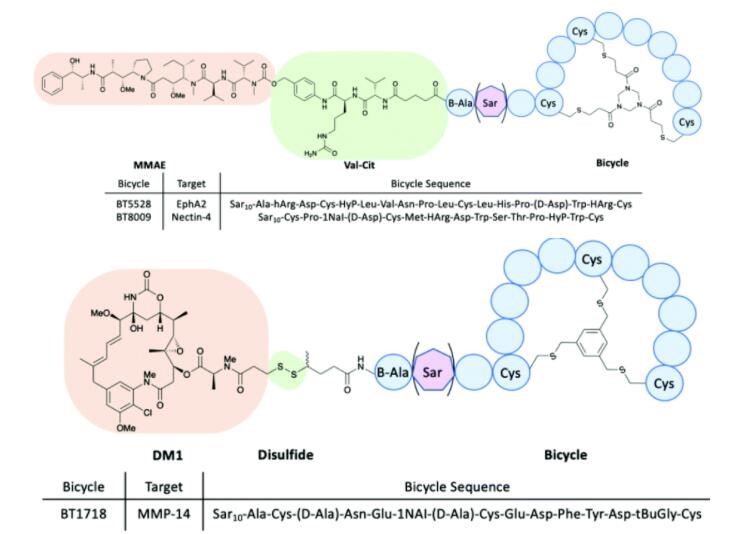
The structure of the bicyclic peptide toxin conjugate developed by Bicycle
Currently Bicycle Therapeutics is developing a number of BTC products, of which BT1718, BT5528 and BT8009 are in clinical trials. The research product BT1718 is in the phase 1/2a clinical stage, and targets type 1 membrane matrix metalloproteinase (MMP-14), which is overexpressed in a variety of tumors (such as ovarian cancer, lung cancer, breast cancer, bladder cancer, etc.) . BT1718 is coupled to MD1 cytotoxin by a specific bicyclic peptide molecule through a cleavable disulfide bond. In phase 1 clinical trials, BT1718 demonstrated good safety, tolerability and efficacy.
The research product BT5528 targets Ephrin Type A receptor 2 (EphA2) and is in phase 1/2 clinical trials. EphA2 is overexpressed in a variety of tumors and is a member of the tyrosine kinase family. This receptor family plays an important role in many physiological processes, including cell migration, adhesion, proliferation and differentiation. BT5528 is connected to the MMAE payload by a bicyclic peptide molecule through an enzymatically cleavable Val-Cit linker. Another product under development, BT8009, targets Nectin-4, which is similar in structure to BT5528, is also connected to the MMAE payload through a Val-Cit cleavable linker.

Bicycle’s research pipeline (picture source: Bicycle’s official website)
Dendrimers are characterized by their highly branched structure, consisting of multiple layers, including a core, multiple intermediate layers, and outer shells. Different from linear peptides and polymers, dendrimers exhibit unique characteristics in terms of thermal properties, viscosity, and encapsulation. Peptide dendrimers can be divided into two categories: covalent peptide dendrimers and non-covalent peptide dendrimers. The payload is attached to the dendrimer through electrostatic or hydrophobic hydrogen bonds. Because of its adjustable amino acid characteristics and good biocompatibility, the use of peptide dendrimers is considered to have great potential. In one study, researchers used peptide dendrimers macromolecular drug conjugates to selectively deliver doxorubicin (DOX) to cancer sites, which can significantly reduce tumor size in a mouse model. In another study, researchers demonstrated that peptide dendrimers had the potential to treat colorectal cancer by controlling the drug delivery of gemcitabine (GEM).
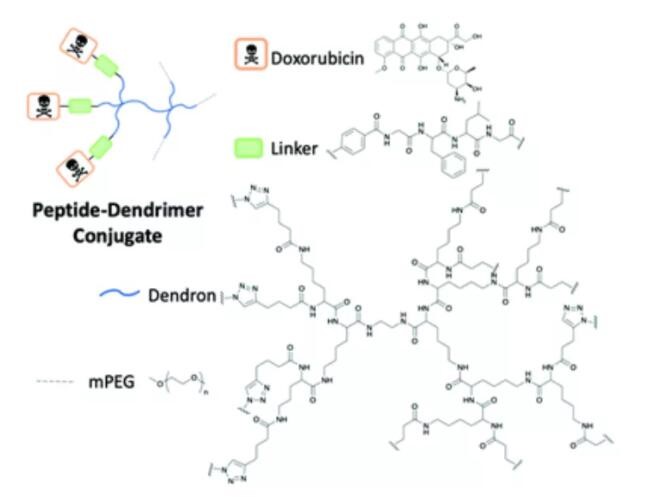
The structure of the peptide-dendrimer conjugate for doxorubicin delivery
Melflufen, which has just been approved by Oncopeptides, is prepared by coupling an alkylating agent with a peptide targeting aminopeptidase. Melflufen can be quickly taken up by MM cells due to its lipophilicity. In the cells, it will be rapidly hydrolyzed by peptidase, thereby releasing the hydrophilic alkylating agent. Aminopeptidase is overexpressed in tumor cells, especially in advanced cancers or tumors with high mutation load. Because melflufen can increase the concentration of alkylating agent in cells, its killing effect on MM cells is better.
We hope that with the progress of technology, more PDC drugs will be available as soon as possible to benefit more patients.
]]>Last week, Oncopeptides announced that the US FDA has accelerated the approval of its “first-in-class” anti-cancer peptide conjugated drug Pepaxto to be used i combination with dexamethasone for the treatment of relapsed/refractory multiple myeloma (MM) adult patients. The potential of peptide-drug conjugates (PDCs) in targeted therapy has also attracted a lot of attention. This article mainly introduces the basic structure, advantages, and disadvantages of PDC.
A significant limitation of peptides is that they are taken orally, which often destroys their biological activity. Most of the time, they need to be administered intravenously (IV). Compared with biological products, peptides have a shorter circulating half-life, often only a few days to a few weeks, so they need to be administered more frequently.
In addition, most peptides are rapidly cleared by the kidneys in the human body, which makes it difficult to carry out peptide research in vivo. Several methods currently used to improve the druggability of peptides include improving the cell permeability of peptide molecules, enhancing chemical and proteolytic stability, and reducing renal clearance, thereby prolonging the circulatory half-life.
Specifically, methods for improving the enzymatic and chemical stability of polypeptides through chemical modification include:
- Cyclization technology
Cyclization technology has been widely used in the field of peptides, and cyclization has been achieved in a variety of ways: including head to tail, head/tail to side chain, or side chain to side chain;
- Protein modification
The side chain of amino acids provides another good source for protein modification. As the enzyme recognition site is destroyed, the increase in the volume of the side chain will increase its stability;
- Reduce renal clearance through chemical modification;
- Improve the oral bioavailability of peptide therapeutics through formulations, including penetration enhancers and acid-stable coatings.
Faced with the huge unmet clinical needs for cancer treatment, antibody-conjugated drugs (ADC) have received more and more attention. In 2000, Mylotarg (gemtuzumab ozogamicin) became the first ADC drug approved by the FDA, which was composed of an antibody targeting the leukemia cell surface antigen CD33 combined with a cytotoxic payload derived from calicheamicin. In the past 20 years, many ADCs have been approved for the treatment of various cancers. As of September 2020, the FDA has approved a total of 9 ADC drugs. Although ADC continues to improve, there are still several shortcomings:
- First, as cytotoxic drugs, ADCs can cause significant side effects;
- Secondly, the complex structure of ADC leads to high production costs;
- Finally, due to the high molecular weight and protein-like physical and chemical properties of ADC, its efficacy in the treatment of certain types of solid tumors is not ideal.
To overcome these problems, many researchers are exploring the feasibility of peptide-conjugated drugs (PDCs) in targeted cancer therapy.
Structure of PDC
The structure of PDC is similar to that of ADC, and the only difference is the part of the homing device. PDC is composed of three important components: a homing peptide, a linker, and a cytotoxic payload. The payload is delivered by targeting the receptors of tumor cells. Although ADC is developing rapidly, the development of PDC is relatively slow. Currently, there is only one approved therapeutic PDC, 177Lu-dotatate, for the treatment of gastrointestinal pancreatic neuroendocrine tumors (GEP-NETs).
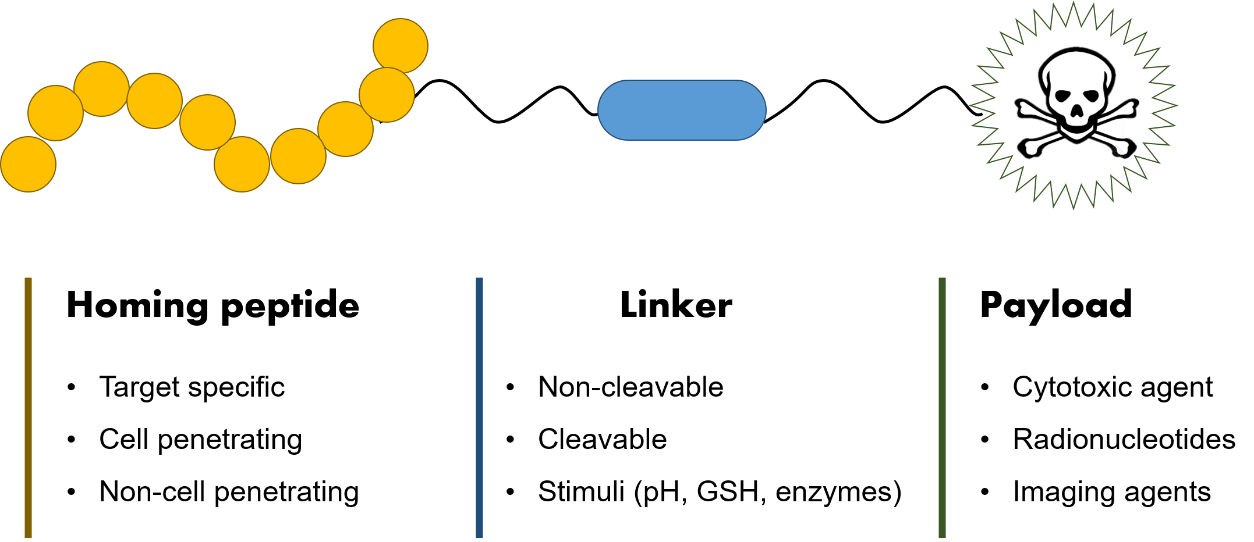
A schematic of a peptide–drug conjugate. Consisting of a homing peptide, a linker, and a payload.
- Homing peptides
Homing peptides can specifically target protein receptors overexpressed on the surface of tumor cells. The secondary structure of the homing peptide has a significant effect on its binding affinity. Most of the homing peptides used so far are linear: although they exhibit good binding properties, they still have several disadvantages, including easy end degradation by enzymes, chemical instability, and rapid clearance by the kidneys. Overcoming these shortcomings can be achieved through methods such as cyclization.
- Linker
According to the required PDC mechanism, different linkers will be used. The linker must maintain stability during delivery to prevent the premature and non-specific release of the drug. Like ADC, the linker used for PDCs can be cleavable or non-cleavable.
- Cytotoxic payload
There are a series of cytotoxic drugs that can be used for cancer treatment, but each drug usually has certain limitations. The biggest limitation is that the drug is non-specific to target cancer cells, which can cause harm to healthy cells and cause serious side effects. The most commonly used payloads in PDC include Doxorubicin, Taxol, Daunorubicin, Gemzar, and Mertansine. PDC can not only be used as a therapeutic drug but also widely used as an imaging agent.
Disadvantages of PDC
Similar to peptides, one of the disadvantages of PDC is its poor circulatory stability and will be quickly cleared by the kidneys. PDC must remain stable in the circulation to prevent the early release of cytotoxic payloads and lead to systemic exposure. There have been studies using different nanoparticles to enhance the stability of PDC.
Another disadvantage of PDC is that the current oral administration efficiency is low, and it needs to be administered by IV injection. Different studies are trying to improve this phenomenon, including different modifications to enhance its chemical and enzymatic stability, and the use of new nanomaterials that deliver peptides and proteins in a controlled manner.
The latest developments in chemistry and biology have expanded our understanding of the advantages and limitations of peptides and laid the foundation for PDC as a new targeted therapy method. We look forward to the advancement of technology, more PDC drugs will come out as soon as possible, benefiting more patients.
References:
- Bethany M. Cooper, Jessica Iegre, Daniel H. O’ Donovan, Maria Ölwegård Halvarsson and David R. Spring. Peptides as a platform for targeted therapeutics for cancer: peptide–drug conjugates (PDCs). Chemical Society Reviews. 2021; 50:1480-1494.