There are many types of cell-penetrating peptides (CPPs), and their classification is based on physicochemical properties, sources, intake mechanisms, and biomedical applications. There is no unified conclusion yet. According to their physical and chemical properties, CPPs can be divided into three types: cationic, amphiphilic and hydrophobic, among which cationic and amphiphilic CPPs are dominant, accounting for about 85%, while hydrophobic CPPs account for only 15%.
- Cationic Cell-Penetrating Peptides
Cationic cell-penetrating peptides (CPPs) are composed of short peptides rich in arginine, lysine and histidine, such as TAT, Penetratin, Polyarginine, P22N, DPV3 and DPV6. Among them, arginine contains a guanidine group, which is hydrogen-bonded to negatively charged phosphate groups on the cell membrane and mediates CPPs entry into the membrane at physiological PH. Studies on oligo-arginine (from 3 R to 12 R) showed that the membrane penetration capacity was increased when the amount of arginine was at least 8, and the membrane penetration capacity gradually increased with the increase of the amount of arginine. Lysine, though cationic like arginine, does not contain guanidine, so when it is alone, its transmembrane efficiency is not too high.
- Amphiphilic Cell-Penetrating Peptides
The amphiphilic cell-penetrating peptides is composed of hydrophilic and hydrophobic domains, and can be divided into primary amphiphilic, secondary α-helix amphiphilic, β-folded amphiphilic and proline-enriched amphiphilic.
- Hydrophobic Cell-Penetrating Peptides
Hydrophobic cell-penetrating peptides contain only non-polar amino acid residues, the net charge is less than 20% of the total charge of the amino acid sequence, or contain hydrophobic motifs or chemical groups that are crucial for membrane penetration. Although often overlooked, these cell-penetrating peptides do exist, such as fibroblast growth factor (K-FGF) and fibroblast growth factor 12 (F-GF12) derived from Kaposi’s sarcoma.
Applications of Cell-Penetrating Peptides
- Treatment of tumors
CPPs can use their membrane-penetrating effects to carry chemotherapeutic drugs or biologic agents into the body, and release the carrier in the cytoplasm or target action sites to maximize the effectiveness of the treatment of the resulting tumor cells. Dubikovskaya et al. linked the penetrating peptide R8 to paclitaxel (PTX), a widely used chemotherapeutic drug, through a biolysable disulfide ligand. After penetrating the cell membrane, it encountered the chemical bond of the coupling with high concentration of glutathione, resulting in its cleavage. Studies have shown that CPP-paclitaxel compounds are more effective than paclitaxel alone in both in vitro cell cultures and animal models. The activity of the drug was also observed in paclitaxel-resistant cells.
- Oligonucleotide and siRNA delivery
Peptide, protein and gene-based biomacromolecules play an important role in the treatment of many diseases. However, due to their large size and low lipophile characteristics, they cannot effectively cross the cell membrane, so the application of these biomacromolecules with therapeutic value in medical fields is greatly limited. Currently, the commonly used methods for introducing biological macromolecules into cells include liposome mediated method, virus vector mediated method, electroporation method and microinjection method, etc. However, these methods have disadvantages such as low transport efficiency, high cytotoxicity, poor safety and poor targeting specificity, which greatly limit their large-scale application. Therefore, the development of efficient and safe transmembrane transport technology of biological macromolecules has become an important challenge, and the discovery of cell-penetrating peptides (CPPs) provides a new way to solve the above problems.
Oligonucleotides and siRNA are important tools for regulating protein activation and post-transcriptional gene expression, and are important means for targeted therapy of specific genes. siRNA can play its role in gene therapy through post-transcriptional gene silencing. Li et al constructed a novel siRNA delivery system sTOLP(loaded with siRNAOA-R8 / TF-modified LNP) for cell penetrating peptioyl-octadecarginine (OA-R8) transferrin (Tf)-modified multifunctional lipid nanoparticles (LNP). siRNA encapsulated in sTOLP showed strong tumor inhibition (61.7%) and was preferentially absorbed by hepatocytes and tumor cells in HepG2-containing mice without inducing immunogenicity or hepatic or renal toxicity.
- Inflammation-targeted therapy
Nuclear transcription factor kappaB (NF-κB) is an important transcriptional regulator in cells. It usually binds to its inhibitory protein in a non-activated state in the form of P50-P65 dimer. Many inflammatory responses are strongly associated with NF-κB activation. By combining CPP (8K, octa-yLysine) with NF-κB essential regulator binding domain (NBD), Dave et al. treated mice with inflammatory bowel disease by intraperitoneal injection. The results showed that the activation of NF-κB was inhibited in the treated mice, and inflammatory cytokines TNF-α, IL-6 and IL-1 showed a decreasing trend, and intestinal inflammation was improved.
- Bactericidal effect
Broad-spectrum antibiotics are difficult to inhibit or kill intracellular bacteria, which cause great harm to animal and human health, especially zoonotic infectious diseases. Due to the selective permeability of cell membrane, drugs can not penetrate the barrier, resulting in the efficacy of the ideal state. Some researchers attempted to connect CPP to peptide nucleic acids (PNAs), which could effectively kill intracellular listeria and caenorhabditis elegans (Milletti,2012), providing ideas for the design of intracellular bactericidal drugs introduced by CPP to a certain extent. The penetrating CPPs can bind specific bactericidal active substances into cells through direct transport or endocytosis, and the specific bactericidal active substances can play a selective therapeutic role in cells, thus providing a more feasible solution for the treatment of intracellular bacteria.
- Imaging
CPPs, which uses its internalization as a carrier to deliver fluorescent particles into cells, has been a promising tool for imaging agents, contrast agents and quantum dot delivery. This imaging technique has the advantage of being able to visualize and quantify biomarkers, biochemical and intracellular processes, detect the stages of disease, identify the extent of disease and measure the effectiveness of treatment.
- Viral Delivery Peptide
CPPs can also be used to increase the transduction efficiency of viruses. CPP-modified Adv as a delivery vehicle is a promising tool for cell transduction and gene therapy.
]]>
- Scientists are expected to develop a new type of cellular permeable peptide chimera to promote wound healing.
In recent years, cell penetrating peptides as drug delivery carriers have aroused great interest among scientists. They may help develop new therapeutic agents or cosmetics. In general, compounds with a molecular weight greater than 500Da can hardly pass through the biofilm. In a recent study, researchers covalently combined a sequence that promotes wound healing with cellular osmotic peptides to improve the efficiency of drug transport in cell membranes. The new peptides ingested by cells can be conjugated into keratin cells, which can significantly improve drug transport under good tolerance.
- AJP: Intestinal peptide is helpful to improve the success rate of corneal transplantation.
A recent article published in the journal American Journal of Pathology found for the first time that injecting neuropeptide (VIP), into the eyes of mice could improve the success rate of corneal transplantation. VIP also has other advantages, such as accelerating wound healing, protecting corneal endothelial cells and improving the cleanliness of corneal transplantation. If the treatment is approved, it will help solve the problems of many patients with corneal diseases.
- Cancer Cell: Scientists develop peptide drugs for accurate treatment of prostate cancer.
In a new study recently published in the international academic journal Cancer Cell, researchers from the University of Michigan developed a new treatment strategy that targets genetic mutations in about half of prostate cancer. When the two genes, TMPRSS2 and ERG, are relocated and fused on chromosomes, prostate cancer development is turned on. However, the development of small molecule inhibitors targeting ERG has always been a great challenge.
- Nature journal: Magic peptides that can effectively deal with drug-resistant bacteria.
Worldwide abuse of antibiotics has received a lot of attention recently. As a result of excessive use of antibiotics, more and more bacteria have developed drug resistance, resulting in the emergence of “superbugs”. At the same time, the development of new antibiotics has not been able to keep pace with the evolution of bacteria. According to the World Health Organization, 10 million people could die of drug-resistant bacteria each year by 2050. In order to update the arsenal of weapons to deal with bacteria, some scientists have taken different measures. Recently, researchers from the Massachusetts Institute of Technology, the University of Brasilia and the University of British Columbia in Canada have designed an antibacterial peptide that can destroy many kinds of bacteria, including drug-resistant bacteria. The results were published in the journal Scientific Reports.

- Tuberculosis: Specific peptides from fungi are expected to treat tuberculosis.
In a recent study published in the international journal Tuberculosis, scientists from Lund University found that. A special peptide isolated from saprophytic ascomycetes (Pseudoplectania nigrella) is expected to be used as a new antibiotic to inhibit the growth of Mycobacterium tuberculosis.
- Hypertension: Peptides in spirulina may have obvious antihypertensive effect.
In a recent study published in the international journal Hypertension, scientists from institutions such as the University of Rome said that a peptide extracted from spirulina may be able to fight high blood pressure by dilating blood vessels. The results are expected to help researchers develop new treatments for hypertension at a later stage.

- Ang Chem Int Ed: scientists have developed new macrocyclic peptides that are expected to treat Alzheimer’s disease and type 2 diabetes.
At present, researchers have not developed effective treatments to resist the formation of amyloid protein in patients with Alzheimer’s disease and type 2 diabetes mellitus. Recently, scientists from the Technical University of Munich have found a solution by describing a new macrocyclic peptide molecule that can effectively inhibit the formation of amyloid proteins. The study was published in the international journal Angewandte Chemie International Edition.
- Diabetes: Natural peptides may improve glucose and insulin sensitivity and reduce body weight.
In a recent study published in the international journal Diabetes, researchers from the University of California found that obese mice were treated with peptides naturally found in the body called catechol somatostatin (CST). Or can significantly improve the level of glucose and insulin tolerance in mice, but also reduce the body weight of mice. The researchers point out that CST plays a key role in the recruitment and function of macrophages in the liver, as well as in regulating obesity-related liver inflammation and insulin tolerance.
- PLoS ONE: novel peptides can kill neuroma cells by blocking DNA replication.
Neurocytoma is one of the cancers that cause childhood death, accounting for 15% of childhood cancer deaths, and the 5-year survival time of high-risk neuroma patients is often 40% to 50%. Recently, in a research paper published in the international journal PLoS ONE, researchers found that a peptide called R9-caPep can target neuroma cells. It destroys the proliferation of nuclear antigen (PCNA) to kill neurocytoma cells. PCNA is an essential protein for DNA synthesis, replication and repair of neuroma cells.
- Immunity: A host defense peptide in frog mucus can kill many influenza virus strains.
Frog mucus contains molecules that kill bacteria and viruses, and scientists are beginning to study its use as a potential source of a new antimicrobial drug. In a new study, researchers from Emory University, Mount Sinai Icahn Medical School and the Rajiv-Gandhi Biotechnology Center in India reported that in Hydrophylax bahuvistara, a brightly colored tennis-sized frog species in southern India, A host defense peptide can eliminate a variety of influenza virus strains. The researchers named the newly identified peptide “urumin,” and the results are published in the journal Immunity.
]]>
A novel cell-permeable peptide chimera to promote wound healing
In a recent study, researchers covalently combined a wound healing promoting sequence with cellular osmotic peptides to improve the efficiency of drug delivery through the cell membrane. In the study of cellular internalization, the researchers found that the novel peptides ingested by cells can conjugate into keratin cells and thus significantly improve drug transport under good tolerance. In this study, the researchers analyzed the effect of a novel polypeptide chimera (Tylotoin-sC18*) on wound healing. The results showed that the fusion of peptide with (Tylotoin) did not induce loss of its activity. The researchers also observed the effect of its proliferation on keratinocytes, which may be an important step in wound healing. Tylotoin-sC18* shows strong antibacterial activity and can effectively inhibit bacterial infection in wounds. Because of its multiple functions, the researchers speculated on whether the new polypeptide chimera could be used to treat wound infections in the body; the results are published in the international journal Scientific Reports.

References
1. Horn, M., & Neundorf, I. (2018). Design of a novel cell-permeable chimeric peptide to promote wound healing. Scientific reports, 8(1), 16279.
2. Langel, U. (2006). Handbook of cell-penetrating peptides. CRC press.
3. Mäe, M., & Langel, Ü. (2006). Cell-penetrating peptides as vectors for peptide, protein and oligonucleotide delivery. Current opinion in pharmacology, 6(5), 509-514.
]]>Application of CPPs.
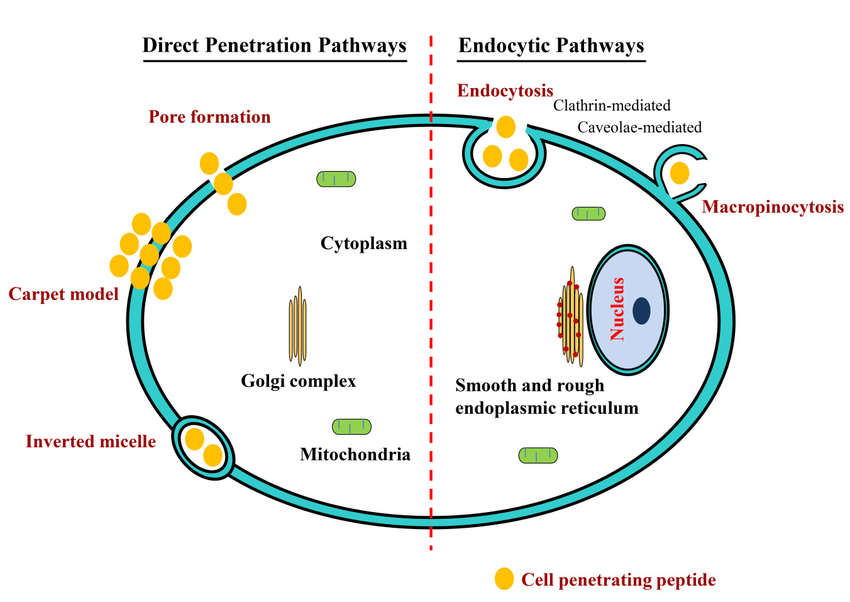
A major obstacle in the development of new therapeutic agents is the low bioavailability of hydrophilic substances. It is well known that, drugs that bind to intracellular targets must penetrate the lipid bilayer membrane surrounding the cell in order to exert their effect. Fortunately, a relatively new research area that addresses this problem by introducing novel transport peptides, which attract many researchers in this field, has emerged. Most researchers look at the delivery of many therapeutic molecules by various CPPs, and their potential therapeutic application in a wide range of areas. These peptides predominantly have a positive net charge and/or an amphipathic nature, but can otherwise have very different characteristics and with the ability to cross the plasma membranes of mammalian cells in an apparently energy- and receptor-independent fashion compared to receptor-mediated carriers. This group of peptides, also sometimes called protein transduction domains (PTDs), is here referred to as cell-penetrating peptides (CPPs). As mentioned previously, the limited therapeutic value of polypeptides and oligonucleotides in biomedical research and as pharmaceutical substances is due to their low biomembrane permeability and their relatively rapid degradation. So people expect that the possibility to manipulate intracellular biological targets would increase if large-sized hydrophobic molecules could be addressed intracellularly, without severe limitation on amounts inherent to the necessity to cross membrane lipid bilayers. Thus, the discovery that CPPs translocate across the plasma membrane of live cells and permit intracellular transport of cargoes, such as conjugated peptides, proteins, oligonucleotides and nanoparticles, although in a still not clarified way, has opened new possibilities and proposed new hopes in biomedical research and therapy.
Although there is much debate over the mechanism by which this “protein transduction” occurs, the ability of CPPs to translocate rapidly into cells is being exploited to deliver a broad range of therapeutics in a variety of situations and biological systems. The ability CPPs to deliver different cargoes in a relatively efficient and non-invasive manner has implications as far reaching as drug delivery, gene transfer, DNA vaccination and beyond. Although many questions remain to be answered and limitations on the use of CPPs exist, it is clear that this emerging technology has much to offer in a clinical setting.
Reference:
Ling Ren. COMPARISON OF CELLULAR UPTAKE OF ARGININE-RICH CELL-PENETRATING PEPTIDES
]]>