Peptide is a type of compound formed by connecting multiple amino acids through peptide bonds, usually composed of 10-100 amino acid molecules, and its connection method is the same as that of protein. The relative molecular mass is less than 10,000. In recent years, with the development and maturity of peptide synthesis technology, peptide drugs have become one of the hot spots of drug research and development. Because of their wide indications, high safety, and remarkable efficacy, they have been widely used in the prevention, diagnosis and treatment of tumors, cardiovascular and cerebrovascular, hepatitis, diabetes, AIDS and other diseases.
Characteristics of peptide drugs
Peptide drugs have high safety and high target affinity. They are mainly eliminated by proteolytic degradation and renal filtration. The products of hydrolysis are amino acids. Therefore, it is generally not considered whether the metabolites of peptide drugs are toxic.
The developed peptide drugs often use endogenous peptides as templates, which usually have a higher target affinity and a smaller risk of off-target.
The probability of peptide drugs being approved for marketing through clinical trials is twice higher than that of small-molecule drugs, and the average R&D cycle is 0.7 years shorter. The development of peptide drugs has also extended to many disease fields, including anti-infection, anti-tumor, physiological regulation, pain, heart failure, osteoporosis, diabetes, vaccines, etc.
Compared with protein, peptide chemical synthesis technology is mature, easy to separate from impurities or by-products, high purity, and easy to introduce unnatural amino acids. However, the quality, purity and yield of recombinant proteins are difficult to guarantee. And the recombinant proteins cannot be introduced with unnatural amino acids and cannot be amidated at the ends. At the same time, the production cycle is long and the cost is high. Peptides are generally lower in cost than protein and antibody drugs, and higher in synthesis cost than most small molecule drugs.
Peptides are easily degraded, have a short half-life and a high plasma clearance rate. The biggest problem with peptides is that they cannot be taken orally, mainly because they are easily degraded and difficult to cross the intestinal mucosa. In addition, peptides are easily hydrolyzed by proteolytic enzymes in the blood after entering the blood, and have a short plasma half-life and plasma clearance rate, which affects the efficacy of the drug and the choice of the route of administration, and therefore does not produce drug accumulation.
Peptide drugs may develop immunogenicity as the number of amino acids increases.
| Drug | Small-molecules | Peptides | Proteins |
| Molecular Weight | < 500 | 500-10000 | >10000 |
| Stability | Better | Good | Bad |
| Activity | Low | High | High |
| Specificity | Weak | Strong | Strong |
| Immunogenicity | No | No or Low | Yes |
| Purity | High | High | Low |
| Cost | Low | High | Higher |
Table 1 Comparison of peptide with small-molecule and protein
Marketed Peptide Drugs
| Type | Name | Length | Company |
| Adrenocorticotropic hormone (ACTH) and its derivatives | Corticorelin | 41aa | Ferring Pharm |
| Cosyntropin | 24aa | Celtic Pharma | |
| Seractide | 39aa | Armour Pharm | |
| Cholecystokinin analogs | Ceruletide | 10aa | Pharmacia and Upjohn, Farmitalia Carlo Erba |
| Sincalide | 8aa | Bracco Diagnostics | |
| Thyroid Stimulating Hormone Releasing Hormone | Taltirelin | 2aa | Tanabe Seiyaku |
| Protirelin | 3aa | Abbott, Ferring Pharms | |
| Growth hormone releasing hormone (GHRH) and analogs | Sermorelin | 29aa | Serono Labs,
Kabi,Pharmacia |
| Somatorelin | 44aa | Ferring Pharm | |
| Tesamorelin | 44aa | Theratechnologies | |
| Secretin | Secretin (human) | 27aa | ChiRhoClin |
| Secretin (porcine) | 27aa | ChiRhoClin | |
| Thymus hormone | Thymalfasin | 28aa | SciClone Pharms International |
| Thymopentin | 5aa | Recordari, Italofarmaco, Johnson & Johnson | |
| Calcitonin | Salmon Calcitonin | 32aa | AstraZeneca,GNR Pharma,Lafon,Lisapharma,Pharmy II,Sandoz-NovartisPharma,Sanofi-Aventis,TRBPharma,Zambon France |
| Elcatonin | 31aa | Gelacs Innovation | |
| Human Calcitonin | 32aa | Novartis Pharma | |
| Parathyroid hormone derivatives | Teriparatide | 34aa | Eli Lilly |
| Oxytocin analogs and antagonists | Atosiban | 9aa | Ferring Pharms |
| Carbetocin | 8aa | Ferring Pharms | |
| Oxytocin | 9aa | Abbott, APP Pharms, Baxter Healthcare, JHP Pharms, King Pharmas, Novartis Pharma, Teva | |
| Gonadotropin-releasing hormone (GnRH) and analogues | Buserelin | 9aa | Sanofi-Aventis |
| Gonadorelin | 10aa | Baxter Healthcare, Ferring Pharms, Sanofi-Aventis, Wyeth Pharms | |
| Goserelin | 10aa | AstraZeneca | |
| Histrelin | 9aa | Endo Pharms, Roberts Pharma, Shire | |
| Leuprolide | 9aa | Abbott, Alza, AstellasPharma, Bayer, Bedford Labs, Genzyme, Johnson&Johnson, QLT, Sanofi-Aventis, Takeda,Teva, Wyeth | |
| Nafarelin | 10aa | Pfizer, Searle | |
| Triptorelin | 10aa | Debiopharm, Ferring Pharms, Beaufour Ipsen Pharma, Watson Labs | |
| Gonadotropin releasing hormone (GnRH) antagonist | Abarelix | 10aa | Praecis Pharms, Speciality European Pharma |
| Cetrorelix | 10aa | AEterna Zentaris, Merck-Serono | |
| Degarelix | 10aa | Ferring Pharms, Astellas Pharma | |
| Ganirelix | 10aa | Organon | |
| Somatostatin analogs and antagonists | Depreotide | 10aa | Amersham Health, Berlex Labs, CIS bio Intenational, Nycomed Imaging |
| Edotreotide | 7aa | Molecular Insight Pharms | |
| Lanreotide | 8aa | Beaufour Ipsen Pharma, Globopharm, Tercica | |
| Octreotide | 8aa | Abraxis Pharma, Bedford Labs, Sandoz-Novartis Pharma, Sun Pharma, Teva | |
| Pentetreotide | 8aa | Mallinckrodt, Bristol-Myers Squibb | |
| Somatostatin | 14aa | Merck-Serono | |
| Vapreotide | 8aa | Debiopharm, H3 Pharma | |
| Vasopressin analogs | Argipressin | 9aa | Monasrch/King Pharms |
| Desmopressin | 9aa | Apotex, Bausch & Lomb Pharms, Barr Labs, Behring, Ferring Pharms, Hospira, Pharmaceutique Noroit, Sanofi-Aventis, Teva | |
| Lypressin | 9aa | Sandoz-Novartis Pharma | |
| Phenypressin | 9aa | Globopharm | |
| Terlipressin | 12aa | Ferring Pharms | |
| Anti-HIV drugs | Enfuvirtide | 36aa | Roche |
| Central Nervous System | Glatiramer | 4aa | Teva |
| Peripheral nervous system | Ziconotide | 25aa | Elan Pharms |
| Cardiovascular | Saralasin | 8aa | Norwich-Eaton Pharms, Procter & Gamble |
| Bivalirudin | 20aa | Nycomed Pharma, The Medicines Company | |
| Eptifibatide | 7aa | Millennium Pharms, GSK, Schering-Plough | |
| Carperitide | 28aa | Japan Asubio Pharma | |
| Nesiritide | 32aa | Johnson & Johnson | |
| Angiotensin | Icatibant | 10aa | Jerini AG |
| Diabetes | Exenatide | 39aa | Amylin Pharms, Eli Lilly |
| Liraglutide | 31aa | Novo Nordisk | |
| Lixisenatide | 44aa | Sanofi-Aventis | |
| Albiglutide | 30aa | GSK | |
| Dulaglutide | 46aa | Eli Lilly | |
| Pramlintide | 37aa | Amylin Pharms | |
| Others | Linasclotide | cyclic peptide | Ironwood Pharmaceuticals/Forest Laboratories, Almirall |
| Sinaspultide | 21aa | Discovery Labs | |
| Pasireotide | cyclic peptide | Novartis | |
| Teduglutide | 33aa | NPS Pharms, Nycomed | |
| Peginesatide | 42aa | Affymax,takeda | |
| Pentagastrin | 5aa | Cambridge Labs, SERB Labs, Wyeth-Ayerst Labs | |
| Aviptadil | 28aa | Senatalk |
In the future, the number of peptide drugs in the world will continue to increase. There is no shortage of innovations in peptide drugs and they have great potential. In the future, emerging peptide drugs such as antimicrobial peptides, peptide vaccines, peptide carriers, PDC drugs, etc., are still in the clinical research stage and have very good market prospects. Antimicrobial peptides, as new and powerful broad-spectrum antibiotics, are different from previous antibiotics, and have the advantages of improving immunity and not easy to develop drug resistance. Peptide vaccines use certain peptides to have immunogenicity. They are currently on the market in the field of hepatitis treatment, and a new generation of peptide vaccines in the field of Ebola and AIDS are under development.
]]>Last week, Oncopeptides announced that the US FDA has accelerated the approval of its “first-in-class” anti-cancer peptide conjugated drug Pepaxto to be used i combination with dexamethasone for the treatment of relapsed/refractory multiple myeloma (MM) adult patients. The potential of peptide-drug conjugates (PDCs) in targeted therapy has also attracted a lot of attention. This article mainly introduces the basic structure, advantages, and disadvantages of PDC.
A significant limitation of peptides is that they are taken orally, which often destroys their biological activity. Most of the time, they need to be administered intravenously (IV). Compared with biological products, peptides have a shorter circulating half-life, often only a few days to a few weeks, so they need to be administered more frequently.
In addition, most peptides are rapidly cleared by the kidneys in the human body, which makes it difficult to carry out peptide research in vivo. Several methods currently used to improve the druggability of peptides include improving the cell permeability of peptide molecules, enhancing chemical and proteolytic stability, and reducing renal clearance, thereby prolonging the circulatory half-life.
Specifically, methods for improving the enzymatic and chemical stability of polypeptides through chemical modification include:
- Cyclization technology
Cyclization technology has been widely used in the field of peptides, and cyclization has been achieved in a variety of ways: including head to tail, head/tail to side chain, or side chain to side chain;
- Protein modification
The side chain of amino acids provides another good source for protein modification. As the enzyme recognition site is destroyed, the increase in the volume of the side chain will increase its stability;
- Reduce renal clearance through chemical modification;
- Improve the oral bioavailability of peptide therapeutics through formulations, including penetration enhancers and acid-stable coatings.
Faced with the huge unmet clinical needs for cancer treatment, antibody-conjugated drugs (ADC) have received more and more attention. In 2000, Mylotarg (gemtuzumab ozogamicin) became the first ADC drug approved by the FDA, which was composed of an antibody targeting the leukemia cell surface antigen CD33 combined with a cytotoxic payload derived from calicheamicin. In the past 20 years, many ADCs have been approved for the treatment of various cancers. As of September 2020, the FDA has approved a total of 9 ADC drugs. Although ADC continues to improve, there are still several shortcomings:
- First, as cytotoxic drugs, ADCs can cause significant side effects;
- Secondly, the complex structure of ADC leads to high production costs;
- Finally, due to the high molecular weight and protein-like physical and chemical properties of ADC, its efficacy in the treatment of certain types of solid tumors is not ideal.
To overcome these problems, many researchers are exploring the feasibility of peptide-conjugated drugs (PDCs) in targeted cancer therapy.
Structure of PDC
The structure of PDC is similar to that of ADC, and the only difference is the part of the homing device. PDC is composed of three important components: a homing peptide, a linker, and a cytotoxic payload. The payload is delivered by targeting the receptors of tumor cells. Although ADC is developing rapidly, the development of PDC is relatively slow. Currently, there is only one approved therapeutic PDC, 177Lu-dotatate, for the treatment of gastrointestinal pancreatic neuroendocrine tumors (GEP-NETs).
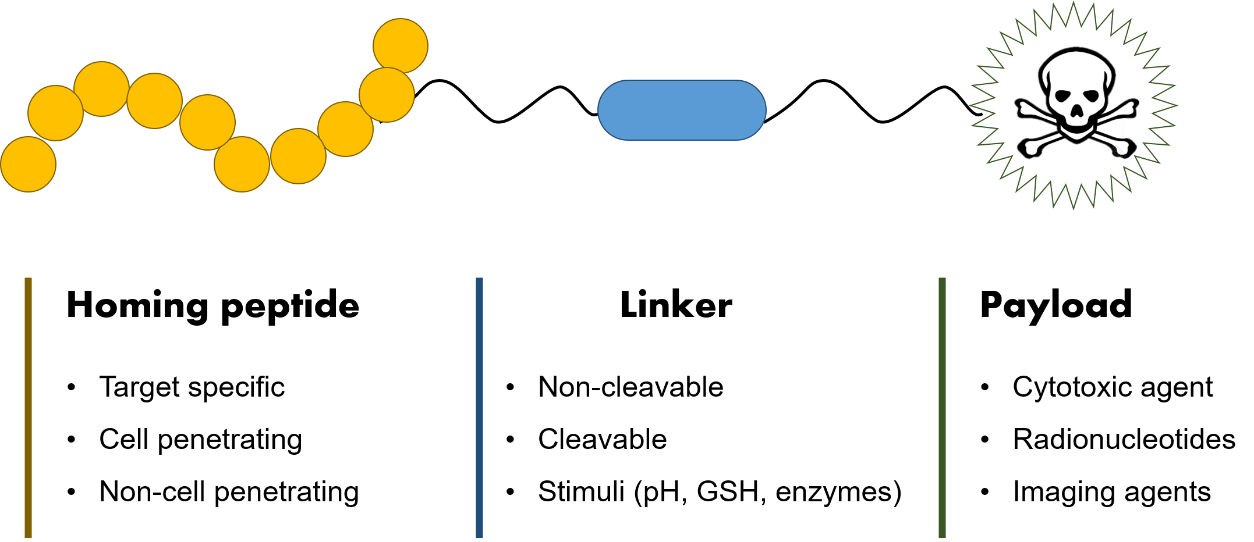
A schematic of a peptide–drug conjugate. Consisting of a homing peptide, a linker, and a payload.
- Homing peptides
Homing peptides can specifically target protein receptors overexpressed on the surface of tumor cells. The secondary structure of the homing peptide has a significant effect on its binding affinity. Most of the homing peptides used so far are linear: although they exhibit good binding properties, they still have several disadvantages, including easy end degradation by enzymes, chemical instability, and rapid clearance by the kidneys. Overcoming these shortcomings can be achieved through methods such as cyclization.
- Linker
According to the required PDC mechanism, different linkers will be used. The linker must maintain stability during delivery to prevent the premature and non-specific release of the drug. Like ADC, the linker used for PDCs can be cleavable or non-cleavable.
- Cytotoxic payload
There are a series of cytotoxic drugs that can be used for cancer treatment, but each drug usually has certain limitations. The biggest limitation is that the drug is non-specific to target cancer cells, which can cause harm to healthy cells and cause serious side effects. The most commonly used payloads in PDC include Doxorubicin, Taxol, Daunorubicin, Gemzar, and Mertansine. PDC can not only be used as a therapeutic drug but also widely used as an imaging agent.
Disadvantages of PDC
Similar to peptides, one of the disadvantages of PDC is its poor circulatory stability and will be quickly cleared by the kidneys. PDC must remain stable in the circulation to prevent the early release of cytotoxic payloads and lead to systemic exposure. There have been studies using different nanoparticles to enhance the stability of PDC.
Another disadvantage of PDC is that the current oral administration efficiency is low, and it needs to be administered by IV injection. Different studies are trying to improve this phenomenon, including different modifications to enhance its chemical and enzymatic stability, and the use of new nanomaterials that deliver peptides and proteins in a controlled manner.
The latest developments in chemistry and biology have expanded our understanding of the advantages and limitations of peptides and laid the foundation for PDC as a new targeted therapy method. We look forward to the advancement of technology, more PDC drugs will come out as soon as possible, benefiting more patients.
References:
- Bethany M. Cooper, Jessica Iegre, Daniel H. O’ Donovan, Maria Ölwegård Halvarsson and David R. Spring. Peptides as a platform for targeted therapeutics for cancer: peptide–drug conjugates (PDCs). Chemical Society Reviews. 2021; 50:1480-1494.
In a new study, researchers from University College London, UK, reported a chemoselective, high-yield α-amino nitrile link. This α-amino nitrile connection only uses the molecules that may exist before the origin of life-hydrogen sulfide, thioacetate, ferricyanide or cyanoacetylene to produce α-peptides in water. The results of the study, entitled “Peptide ligation by chemoselective aminonitrile coupling in the water”, were published online in the journal Nature on July 10, 2019.
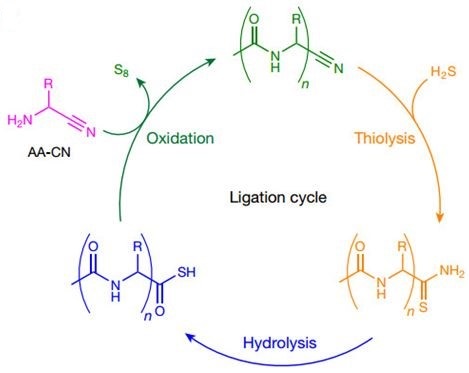
“Peptides are long chains of amino acids that are a key element of all life on Earth,” explained Professor Matthew Powner of University College London, who led the study, “they can further form proteins. In charge of the biological process. “Although scientists have clarified the relationship between amino acids, peptides, and proteins, a key question about the origin of life has never been solved: the synthesis of peptides from amino acids requires the involvement of enzymes; The enzyme that dominates this step is a protein; but to synthesize this protein, we need amino acids to synthesize peptides first. “This is a classic ‘chicken first or egg first’ question.” Professor Powner added.
Previously, many scientists have been studying how amino acids spontaneously form peptides. However, the conditions required for the reaction are extremely harsh and difficult to achieve. In the study, the team focused on aminonitriles, the precursor of amino acids. They found that these molecules are inherently reactive and can directly form peptides without first converting them into amino acids. In other words, the researchers have found a way to synthesize peptides without the need for amino acids.
α-amino nitrile coupling has high selectivity for α-amino nitrile coupling, so there is no need for the existence of the amino acids of these 20 proteins. Two basic characteristics make the peptide binding in water: the reactivity of α-amino nitrile and pKaH make them connect under neutral pH. N-acylation keeps the peptide product produced by this connection stable and activates the peptide precursor, thus achieving biologically simulated N-C peptide binding.
This model unifies the synthesis of amino nitrile and biological α-peptide before the origin of life, and points out that the shorter N-acyl peptide nitrile is a potentially feasible substrate in the process of early evolution.
References
- Canavelli, P., Islam, S., & Powner, M. W. (2019). Peptide ligation by chemoselective aminonitrile coupling in water. Nature.
Recently, discovery of an incretin hormone that can efficiently regulate glucose homeostasis brought about a new therapeutic target in diabetes research. Glucagon-Like-Peptide-1 (GLP-1) is an incretin hormone that is secreted from small intestine in response to glucose levels in plasma. After binding to its cognate receptor (GLP-1R), GLP-1 stimulates release of insulin from pancreatic islets that starts the insulin-signaling cascade and ends up with storage of excess glucose as glycogen. Apart from its glucose lowering properties, GLP-1 also induces satiety after meals and slows down digestion by ceasing gastric emptying which both prevent overeating. This aspect of the peptide makes it even a more potent target as a therapeutic due to possible uses in obesity treatment. GLP-1 itself is also well controlled in the body. First, it is strictly glucose-dependent and therefore secreted when there is an increase in glucose levels. Secretion proceeds in a dose-dependent manner. Second, immediately after GLP-1 reaches circulation, a ubiquitous protease dipeptidyl peptidase IV (DPP-IV) hydrolyses the N-terminus end, rendering it inactive. Although this second feedback mechanism plays an important role in glucose homeostasis in healthy individuals, it constitutes a challenge for using GLP-1 as a therapeutic compound for diabetic patients due to stability problems.
It should be mentioned here that GLP-1 is not the only peptide drug option for diabetes. Amylin is another gastrointestinal peptide that has been identified as a potential therapeutic target. It is secreted after food intake from pancreatic cells, along with insulin. Advanced diabetic patients lack amylin due to loss of β-islets. Although mechanism of action is not well understood, it was shown to suppress glucagon secretion in a glucose-dependent manner and delay gastric emptying. Pramlintide is a synthetic amylin analog that has been approved by the FDA in 2005 for treatment of both Type I and Type II diabetes.
Challenges and drawbacks of peptide drugs
Among many reasons that peptides have been held back from being developed as drugs, low bioavailability is significant. Administration is generally intravenous injection in order to reach the target quickly without getting degraded along the way. Due to numerous proteolytic enzymes in the digestive tract and harsh gastric acid, oral administration is not applicable for peptides. Blood plasma also contains proteases that are responsible for degradation of any immunogenic peptide, therefore shortening the half-life of peptide drugs. Clearance can also be very rapid (mins) via hepatic (liver) and renal (kidneys) routes. Hydrophilicity of a peptide chain can also make it difficult to pass through biological membranes and reach to target organs. Therefore, even for an injectable peptide drug, chemical elaborations of the peptide structure are required to overcome these problems. Compared to protein and antibody drugs, peptides have more potential to be modified and mutated without compromising their activity. Several modifications that are commonly used are amino acid sequence mutations, PEGylation, cyclisation and glycosylation.
In order to enhance the plasma half-life of peptide drugs, chemical alterations such as C-terminal amidation and N-terminal acetylations, and amino acid substitution at protease sensitive sites are often utilized. Most of the time, poor protease stability of α-peptides cannot be improved by using natural L-α-amino acids. In order to maintain a longer plasma life, unnatural amino acids such as D-α-amino acids, side chain modified L-α-amino acids and amino acids with unnatural backbone (β- or γ-amino acids) are used.
Cyclization is another method for increasing proteolytic stability. It can be done via disulfide bond between two cysteine residues or head-to-tail cyclization via amide bond.
Attachment of polyethylene glycol (PEG) increases plasma resistance of the peptides and improves the solubility of larger proteins without affecting their activity. For example, PEGylation of Interferon-α has been shown to extent its serum life. In another case, high molecular weight PEG attachment to trichosantin has yielded low immunogenicty in the new conjugate, due to transfer of non-immunogenic properties of the PEG to the new compound.
Glycosylation is also shown to have dramatic effects on half-life and the immunogenicity of protein drugs. The half-life of the native erythropoietin23 has been improved by extra glycosylations on the protein.
Reference:
Diren Pamuk, Design and engineering of new glucagonlike-peptide-1 analogues.
]]>To analyze the whole protein complement that can be expressed by a particular cell, the two dimensional- (2D) gel electrophoresis should be employed, which consist of a isoelectric focusing step in one direction of the gel and the SDS-PAGE step in the second direction of the gel. Only one sample can be analyzed on a single gel, but a higher resolution can be achieved this way. Still some protein mixtures may be too complex to be analyzed without prior fractionation; therefore most protein analysis should include some form of separation and purification before more complex analysis methods are employed. Usually any type of column chromatography, like size exclusion, ion- exchange, hydrophobic interaction or affinity chromatography is used to separate the protein mixture into smaller fractions that can then be analyzed and characterized. While the previously mentioned techniques are useful to separate and characterize a protein or peptide based on charge or molecular size, they are not capable of identifying the protein or peptide.
A traditional technique to identify the sequence of a protein or peptide is the Edman degradation procedure, where a peptide is degraded stepwise by phenylisothiocyanate, cleaved by trifluoroacetic acid and converted in aqueous HCl to phenylthiohydantoin, repeatedly until the entire protein is sequenced. Since this process is slow and has a low throughput it is no longer used in most proteomics research.
The major advancement in proteomics research came with the reliable adaptation of mass spectrometry (MS) for peptide analysis. Since most proteins are too large and complex for direct MS analysis a pre-digestion into smaller peptides by specific proteases, for example trypsin, is usually performed before analysis. In mass spectrometry the fragmented molecules are characterized by their mass to charge ratio (m/z). In order to be analyzed the particles have to be ionized into a gas-phase and are then analyzed by a mass analyzer which is coupled with a ion detector to determine the mass to charge ratio of the ion. Mass spectrometers are differentiated by their ionization source, their ion detector and mass analyzer. The most common ionization sources are MALDI (Matrix-assisted laser desorption ionization) and ESI (Electrospray ionization). Mass analyzer and ion detectors used are TOF (Time of Flight) analyzer, Quadrupol mass filter and Ion traps, such as three-dimensional Quadrupol ion trap, linear Quadrupol ion trap and orbitrap. Another common approach is the use of tandem mass spectrometry or MS/MS, where the ionized peptides are first resolved in the first mass analyzer, which separates and isolates one species at a time that is then sent to a collision cell. In the collision cell the peptide is further fragmented, and then sent to the second mass analyzer. There the mass of the fragments is precisely analyzed and a partial amino acid sequence of the peptide can be determined. These partial sequences, called peptide sequence tags, can then be used in database searches to identify the protein or peptide.
The final step after mass spectrometry analysis is to identify the protein or peptide sequence by database search or De novo sequencing. The large amount of peptide sequence tags, generated by the mass spectrometer can be compared to a database of known protein and peptide sequences to identify the actual proteins and peptide present in the sample. Databases like UniProt or SwissProt contain large amounts of information regarding protein and peptide sequences for a large variety of species. Search engines like SEQUEST or PEAKS are employed to compare the mass spectrometry results to the databases and identify the proteins with a certain amount of accuracy, defined by probability parameters. To identify the error rate of false identification of certain amino acid sequences a decoy database search can be employed, where, the mass spectra are compared to the original database and a database where the amino acid sequences are reversed. A match in both databases would be considered false and increase the False Discovery Rate (FDR) of the protein or peptide detection.
When the protein or peptide sequence is not known in any database De novo sequencing can be employed to determine the peptide amino acid sequence. De novo means “anew” or “all over” and describes the fact that the peptide has to be characterized without additional knowledge. In this regard the Edman degradation can be characterized as De novo sequencing. In mass spectrometry a labeling technique for the C-terminal amino acid can be used to identify the side by the additional mass in the mass spectrometer and the correct sequence of a peptide can be analyzed by tandem mass spectrometry. Of course the more information is available of the original protein or peptide the more accurate are the results of the mass spectrometry analysis.
Reference:
Crynen, S. (2011). Bioactive properties of peptides derived from enzymatic hydrolysis of cod muscle myosin with trypsin, chymotrypsin and elastase. University of Florida.
]]>Peptides can regulate the body’s physiological function and provide nutrition to the body. It almost affects the body of all metabolic synthesis. Peptides may be subdivided into oligopeptides and polypeptides. Oligopeptides are made up of two and ten amino acids. And polypeptides are made up of more than ten amino acids. But when up to fifty amino acids, it was called protein. Here, we described the research history of peptide simply.
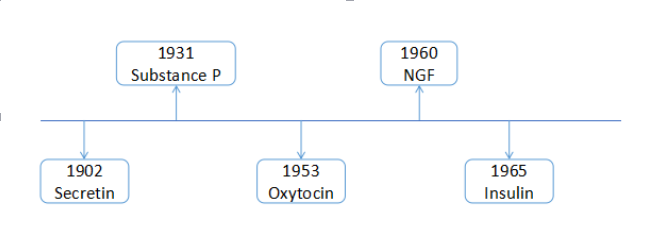
In 1902, Starling and Bayliss discovered the secretin. They showed that when acid arrived from the stomach it liberated a chemical messenger from the jejunal mucosa, and this messenger traveled through the blood to excite the pancreas to secrete pancreatic juice. This is the first time that human find the peptide. As a result of this discovery, it pioneered the function of peptides in endocrinology. Besides, the Nobel Prize Committee awarded them the Nobel Prize in Physiology.
In 1931, Substance P (SP) was discovered by Ulf von Euler and John H. Gaddum as a tissue extract that caused intestinal contraction in vitro. It is also is a potent vasodilator. Scientists began to pay close attention to the effect of peptides to nervous system and called these substances as neuropeptides.
In 1953, Vincent du Vigneaud studied oxytocin, a hormone that among other things plays a role in sexual intimacy and reproduction among people and mammals. He succeeded in isolating the substance and determining its chemical composition. It became the first peptide hormone to have its sequence of amino acids determined. He also succeeded in producing oxytocin by artificial means.
In 1960, Rita Levi-Montalcini and Stanley Cohen identified a compound, expressed by peripheral cells, that attracted spinal neurons and induced neurite formation. Then they isolated this substance from tumors, snake venom, and mouse salivary glands-all in the face of relentless skepticism from the scientific community. Later, this compound was called nerve growth factor (NGF).
At the end of the 1950s, Robert Bruce Merrifield invent solid-phase peptide synthesis (SPPS).
In 1965, scientists from China completed the synthesis of insulin, which is the world’s first synthetic peptide.
Beginning in 1970, neuropeptide become the research hotspot. Then enkephalin and opioid peptides have been found.
Since the biochemists synthesised peptides by artificial methods for more than 40 years. With the rapid development of molecular biology and biochemical technology, peptide research has made amazing progress.
]]> To be general, peptide can be regarded as a compound consisting of two or more amino acids linked in a chain, the carboxyl group of each acid being joined to the amino group of the next by a bond of unique type. In fact, among the amino acids of the peptide , the most dramatic change was the Phe residue. Clearly, peptide is a crucial element in the developing process of biological synthesis. Based on the fact, Creative Peptides, which is specialized in the process development and the manufacturing of bioactive peptides, can offer custom peptide synthesis, process development, GMP manufacturing as well as catalog products.
To be more specific, Creative Peptides can offer custom peptide services using a unique portfolio of specific technologies. It has profound expertise in small- and large-scale solid phase peptides synthesis utilizing both Boc- and Fmoc strategies, as well as solution phase peptide synthesis. In addition, Creative Peptides has just started its blog which mainly focuses on the advances in biotechnology, including the frontiers in peptides, biological knowledge, and some other interesting topics. The staff with decades of experience in peptide chemistry will be helpful in the design and synthesis of peptides and related products. Thus, maybe the future peptides will promote medical research to a large degree.
Taking into account of all the details discussed above, although the peptides had different structures, they typically shared a handful of chemical features, such as phyenyl, hydroxyl, carboxylic acid, and isobutyl groups. In this way, Creative Peptides will play a significant role in exploring bioactive peptides. Certainly, the key is to focus on the clinical applications because only in this way can people really benefit from the advance of peptides. Maybe a brighter future for Creative Peptides is already on the corner.
]]>