Surface Plasmon Resonance (SPR) imaging technology is a label-free optical biosensor technology. Due to its sensitive, specific, rapid, and label-free detection, SPR-based immunosensors that coupled with a specific antigen-antibody reaction have become a promising tool for the quantification of bacteria. SPR immunosensors, comprising antibodies coupled to the transducer, have been used for the detection of various bacteria. For direct detection of bacteria, SPR immunosensors are fabricated by immobilizing antibodies which are specific to the target bacteria, on the gold film surface. The SPR response after the immobilization of antibodies is recorded as a reference.
When a solution containing bacteria is brought in contact with the sensor surface coated with antibodies, the target bacteria bind to the antibody. After washing the surface and removing the unbound bacteria, a shift in the SPR response is monitored due to the binding of bacteria to the sensor surface. The shift in the SPR response is proportional to the concentration of the target bacteria. One can employ the linear relation between the number of the bacteria attached to the surface and the response of the SPR immunosensor to prepare a calibration curve. The success of a SPR immunosensor, like all other biosensors, highly depends on the experimental design.
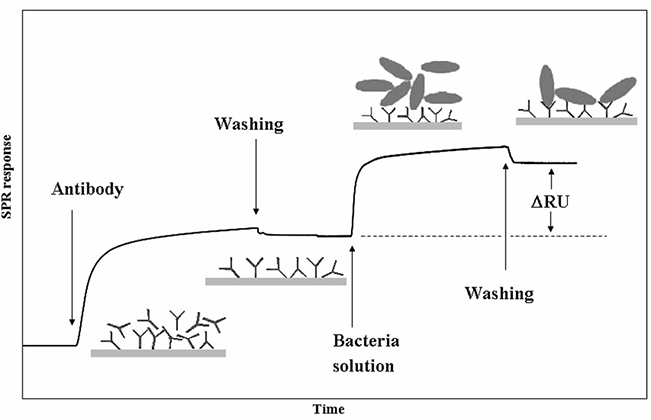 Fig1. The shift in SPR response during the binding of antibody and bacteria to the sensor surface (Biotechnol J, 2009)
Experienced experts and advanced surface plasmon resonance instruments from Creative Peptides will provide our customers with high-precision antibody-bacterial interaction analysis services. Experienced staff at Creative Peptides will help you through your project, including method development, validation, analysis of delivered samples and transfer to the client upon request. We can provide ready-to-publish or ready-to file data in any format required.
Surface Plasmon Resonance (SPR) is a label-free optical biosensor technology that detects interactions between molecules in real time. In antibody-bacteria interaction analysis, SPR measures the binding of bacteria to antibodies immobilized on a sensor surface. The shift in SPR response is proportional to the concentration of bound bacteria, enabling sensitive and rapid detection.
SPR allows for the quantification of bacteria by monitoring the shift in the SPR response when bacteria bind to antibodies on the sensor surface. The amount of binding correlates with the concentration of the bacteria, and a calibration curve can be created to quantify bacteria in a sample accurately.
SPR immunosensors can be customized to detect a wide range of bacteria by using antibodies specific to the target bacteria. These sensors have been successfully used for the detection of various bacterial species in biological and environmental samples.
Yes, we offer customized services for antibody-bacteria interaction analysis. Our team will work closely with you to develop and validate the experimental methods, ensuring that the analysis meets your specific research needs and provides accurate, reliable data.
SPR technology offers several advantages over traditional methods, including real-time detection, label-free operation, high sensitivity, and specificity. It eliminates the need for chemical labels or complex sample preparation, making it a faster and more cost-effective solution for bacteria detection.
We provide ready-to-publish or ready-to-file data in any required format, ensuring that you can seamlessly incorporate the results into your research publications or regulatory submissions. Our team also provides guidance on interpreting the data for further applications.
Our process begins with method development and validation tailored to your specific bacteria and antibody. We then conduct the analysis using our advanced SPR instruments, followed by detailed data analysis and transfer of results. You will be supported throughout the project by our experienced team to ensure accurate and meaningful outcomes.

