Targeted DNA DeliveryDNA-based BiosensorsSite-specific Bioconjugation PlatformLinker Design
At Creative Peptides, we specialize in custom peptide–DNA conjugation—a bioconjugation approach that covalently links synthetic peptides to DNA cargos (e.g., DNA oligonucleotides, DNA aptamers, CpG ODNs, DNA probes, and DNA-tagged constructs) to improve delivery performance and functional integration. Peptide attachment is widely used to address core limitations of nucleic-acid modalities—especially membrane impermeability and biological stability—by introducing cell-penetrating, targeting, or endosomal-escape functionality through well-controlled linker and site-selection strategies. Our team supports enterprise R&D needs with design consultation, controlled conjugation chemistry, and analytical verification aligned to discovery and translational workflows—whether you are building targeted DNA therapeutics, developing DNA-based diagnostics, or engineering peptide–DNA building blocks for advanced nanomedicine and biomolecular assembly.
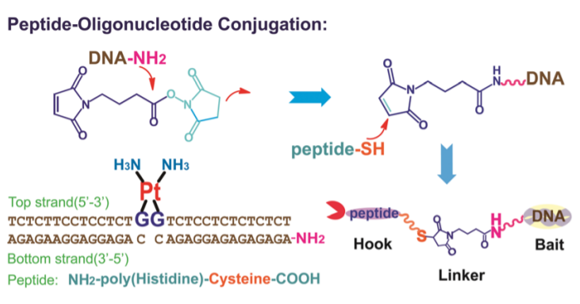
DNA-based modalities can be powerful, but they often encounter practical barriers in biological systems—most notably limited cellular uptake (driven by size and negative charge), susceptibility to enzymatic degradation for certain DNA formats, and inefficient trafficking to the intended intracellular compartment.
Peptide–DNA conjugation is used to address these bottlenecks by:
We provide end-to-end peptide–DNA conjugation services tailored for enterprise customers in biotechnology, pharmaceutical R&D, and advanced diagnostics. Our platform supports discovery through preclinical and GMP-ready programs, integrating peptide chemistry, DNA synthesis, and site-specific bioconjugation under a single, quality-driven workflow. Each module is customizable and guided by experienced scientists with demonstrated expertise in peptide synthesis, DNA chemistry, and translational bioconjugation.
Successful peptide–DNA conjugates begin with rational molecular design. Our scientific team works directly with enterprise R&D groups to define:
Based on these parameters, we deliver a clear technical roadmap, feasibility assessment, estimated yield, and development timeline—supporting informed decision-making for enterprise programs.
Our peptide synthesis capabilities are built on advanced solid-phase peptide synthesis (SPPS) platforms designed to meet the reproducibility and documentation standards expected by enterprise customers.
This ensures peptides are delivered in a conjugation-ready format with performance characteristics suitable for downstream translational research.
We synthesize and modify DNA molecules with precise control over sequence fidelity, chemical stability, and conjugation compatibility, supporting both research and regulated development programs.
Our DNA synthesis workflow emphasizes consistency, traceability, and scalability—key requirements for enterprise customers advancing peptide–DNA conjugates toward commercial milestones.
Conjugation execution is a critical determinant of peptide–DNA conjugate quality, reproducibility, and downstream usability. Our team applies DNA-compatible, site-specific bioconjugation strategies with a focus on molecular control and scalability rather than one-size-fits-all reactions.
This execution-focused approach enables consistent conjugate profiles that integrate smoothly into downstream analytical, diagnostic, or development workflows.
Following conjugation, rigorous purification and analytical characterization are essential to ensure material suitability for enterprise research and development programs. We apply fit-for-purpose analytical workflows aligned with DNA–peptide conjugate complexity.
These analytical controls provide enterprise customers with confidence in conjugate identity, consistency, and readiness for subsequent evaluation or integration.
For selected programs, we provide limited biological evaluation support designed to complement peptide–DNA conjugation development without replacing full biological testing pipelines. This support is intended to generate preliminary, chemistry-focused insights rather than definitive efficacy claims.
This service is offered as a supportive, non-claims-based extension to conjugation development, helping enterprise teams de-risk early-stage design decisions before committing to full biological evaluation programs.
Selecting the right peptide is a key determinant of peptide–DNA conjugate performance. Enterprise programs typically choose peptide motifs to improve cellular uptake, receptor targeting, intracellular trafficking, or stimulus-triggered release, depending on whether the DNA cargo is intended for therapeutic delivery, diagnostics, or molecular assembly.
| Peptide Class | Primary Functional Role | Representative Sequences / Motifs | Typical DNA Conjugation Applications | Design & Delivery Advantages |
|---|---|---|---|---|
| Cell-Penetrating Peptides (CPPs) | Facilitate membrane translocation of DNA cargos | TAT, Penetratin, R8, Transportan, Pep-1 | DNA oligo delivery, intracellular DNA probes, DNA-tagged constructs for cellular assays | Improve cellular uptake; can be combined with cleavable linkers to manage intracellular release |
| Targeting Peptides | Direct peptide–DNA conjugates to specific cells/tissues via receptor binding | RGD/cRGDfK, NGR, Angiopep-2, MSH analogs | Targeted delivery of CpG DNA, DNA aptamers, diagnostic DNA probes, tissue-selective DNA imaging tools | Increases selectivity and tissue specificity; supports ligand-guided uptake in complex biological matrices |
| Endosomal Escape Peptides | Promote endosomal release of internalized DNA cargos | INF7, GALA, HA2, KALA | Intracellular delivery of functional DNA oligos or CpG DNA where cytosolic availability is required | Enhances cytosolic delivery efficiency; often paired with CPP/targeting strategies |
| Nuclear Localization Peptides (NLS) | Increase nuclear access of peptide–DNA constructs (context-dependent) | PKKKRKV, SV40 NLS, M9 | Nuclear-targeted DNA probes, transcription-factor binding studies, nucleus-directed DNA tools | Supports nuclear trafficking strategies when nuclear localization is a functional requirement |
| Mitochondrial Targeting Peptides | Direct DNA cargos toward mitochondria (application-specific) | MTS (e.g., COX8a-derived motifs) | Mitochondrial biology assays, organelle-targeted DNA probes, mitochondrial nucleic-acid research tools | Enables organelle-specific targeting strategies for specialized R&D programs |
| Cleavable / Responsive Peptides | Enable stimulus-dependent release or activation of DNA cargos | Enzyme-cleavable motifs, acid-labile designs, redox-responsive constructs | Tumor-microenvironment release concepts, conditional activation of DNA probes, controlled CpG exposure | Tunable release profiles; supports safety and performance optimization in complex settings |
| Custom Peptides | Project-specific sequences for novel delivery systems or binding functions | Designed per project need | Any peptide–DNA modality (diagnostics, delivery screening, nanomedicine, assays) | Fully customizable; supports proprietary enterprise programs and differentiated IP strategies |
Peptide–DNA conjugation performance depends on DNA format, modification pattern, and intended biological context. Below are common DNA molecule types supported for conjugation-focused R&D, delivery evaluation, and diagnostic assay development.
| DNA Molecule Type | Structural Description | Common Chemical Modifications | Primary Applications | Peptide–DNA Conjugation Rationale |
|---|---|---|---|---|
| DNA Oligonucleotides | Single-stranded DNA (ssDNA) sequences designed for hybridization, binding, or encoding | 5'/3' thiol, amine, azide/alkyne, biotin, fluorophores; spacers/linkers; internal modifications as needed | Hybridization assays, DNA-encoded constructs, molecular probes, biosensing | Adds targeting/uptake motifs; improves trafficking for intracellular probe use; enables site-specific immobilization strategies |
| CpG DNA (CpG ODN) | Immunostimulatory DNA oligonucleotides containing CpG motifs | Terminal functional handles; stabilizing backbone/terminus modifications depending on program goals | Immunology research, vaccine adjuvant R&D, immune pathway profiling | Supports targeted delivery concepts and controlled exposure strategies to specific immune cell populations |
| DNA Aptamers | Structured ssDNA that binds targets via 3D folding (ligand-like behavior) | Biotin, amine, thiol, azide/alkyne; PEG spacers; fluorescent labeling | Target recognition, biomarker detection, targeted binding assays | Adds multifunctionality (e.g., uptake/trafficking peptides) while preserving aptamer recognition through site-controlled conjugation |
| DNA Probes / Primers | Custom DNA sequences for detection, amplification support, or imaging readouts | Fluorophores, quenchers, biotin, spacers, click-ready handles | Molecular diagnostics, imaging workflows, biosensing, hybridization-based assays | Enables precise surface presentation, multiplexing strategies, and targeted intracellular probe delivery when required |
| DNA Tags / Barcodes | Short DNA sequences used as identifiers for multiplexed assays and tracking | Terminal handles; cleavable spacers where workflow requires release; labeling as needed | High-throughput screening workflows, multiplex assays, binding/interaction studies | Supports robust attachment to peptides/proteins/surfaces; improves assay integration and controlled presentation |
| DNA Strands for Nanostructures | Designed DNA strands used in programmable self-assembly (e.g., hybrid structures) | Click-ready handles, spacers, fluorophores, affinity tags | Nanomedicine R&D, biomaterials assembly, programmable biosystems | Combines DNA programmability with peptide biofunction (targeting, binding, responsiveness) in modular architectures |
Chemistry selection determines conjugate stability, release behavior, and manufacturability. Enterprise teams often prioritize site-specificity, scalability, and compatibility with DNA integrity and downstream analytics.
| Conjugation Chemistry | Typical Reactive Handles | Linker / Bond Outcome | Typical Use Cases | Key Considerations |
|---|---|---|---|---|
| Thiol–Maleimide Coupling | Peptide–SH + DNA–maleimide (or DNA–SH + peptide–maleimide) | Stable thioether bond; spacer length customizable | Site-specific peptide attachment to terminally modified DNA oligos; delivery screening constructs | Control of thiol positioning enables reproducibility; handle protection/deprotection strategy affects yield and purity |
| Strain-Promoted Click (SPAAC) | Azide + cyclooctyne (e.g., DBCO) | Triazole linkage; copper-free | Conjugation of sensitive DNA probes/aptamers; biorthogonal assembly workflows | Copper-free conditions reduce compatibility concerns; spacer selection can minimize steric effects on DNA hybridization/aptamer folding |
| CuAAC Click Chemistry | Azide + alkyne (Cu-catalyzed) | Triazole linkage; robust coupling | High-yield conjugation when conditions and downstream requirements permit | Requires catalyst system management and cleanup; selection depends on DNA format sensitivity and downstream biological use |
| EDC/NHS Amidation | Carboxyl + amine (peptide or DNA-modified amine) | Amide bond; typically non-cleavable | Conjugation to carboxylated linkers/spacers; surface/immobilization designs | Best suited to well-defined functional groups and controlled stoichiometry; may require spacer optimization to reduce steric hindrance |
| Disulfide Exchange / Disulfide Linkage | Thiol–thiol (oxidation or exchange strategy) | Redox-cleavable disulfide bond | Intracellular release concepts where reductive environments are leveraged | Stability depends on formulation and biological context; used when triggered release is a functional requirement |
Enterprise peptide–DNA conjugation projects require consistent batch quality, traceability, and fit-for-purpose analytical verification. The following outlines typical deliverables and quality elements aligned with research, preclinical, and GMP-oriented workflows.
| Service Aspect | Research Scale Support | Preclinical / Translational Support | Analytical & QC Methods | Documentation Provided |
|---|---|---|---|---|
| Batch Scale | mg-scale conjugates for screening and assay development | Scale-up planning for extended studies and reproducibility needs | Mass balance and yield reporting per batch | Project-specific production summary and batch traceability notes |
| Purification Strategy | RP-HPLC / UPLC purification to isolate target conjugate from free peptide/DNA | Process optimization for purity targets relevant to downstream use | Chromatographic profiles and fraction tracking | Purification record and QC summary |
| Identity Confirmation | Confirm conjugate identity for R&D readiness | Enhanced characterization planning for data packages | LC-MS (and/or MALDI-TOF as appropriate), UV/Vis | Analytical report including identity confirmation results |
| Purity & Integrity | Purity reporting to support screening reproducibility | Lot-to-lot comparability and stability-oriented checks as needed | Analytical HPLC/UPLC purity; UV quantification; integrity review per construct design | Certificate of Analysis (CoA) and QC data package (as applicable) |
| GMP Readiness Pathway | Feasibility and route selection aligned to scalable chemistries | GMP-compliant manufacturing support pathway (program-dependent) | Defined process controls and release-testing plan aligned to intended use | Batch records, CoA, and supporting QC documentation (program-dependent) |

Design-Driven Conjugation Strategy
Our platform is built around rational molecular design rather than trial-and-error execution. Each peptide–DNA conjugate is planned with clear functional objectives—such as targeting, uptake, or trafficking—ensuring design choices align with biological use cases and downstream development goals.

DNA-Focused Bioconjugation Expertise
We specialize in DNA-compatible chemistries that preserve sequence integrity, hybridization behavior, and structural function. This focus differentiates our platform from generic conjugation services that may not account for DNA-specific stability and performance considerations.

Broad Peptide Functionality Options
Access to a diverse portfolio of cell-penetrating, targeting, endosomal escape, and responsive peptides allows enterprise teams to rapidly evaluate multiple delivery and functional hypotheses within a single, consistent conjugation framework.

Site-Specific & Reproducible Chemistry
Controlled conjugation strategies enable defined stoichiometry and molecular orientation, reducing batch-to-batch variability and supporting reproducibility—an essential requirement for enterprise R&D and translational programs.

Enterprise-Ready Quality & Documentation
From analytical characterization to structured documentation, our platform is aligned with enterprise expectations for traceability, data transparency, and scalability—supporting smooth progression from discovery to regulated development.

Integrated One-Stop Solution
By combining peptide synthesis, DNA synthesis, conjugation, purification, and analytics under one roof, we eliminate cross-vendor risk and accelerate project timelines while maintaining scientific accountability.
Our workflow is designed to provide clarity, reproducibility, and decision-point visibility at every stage of peptide–DNA conjugation projects, supporting both exploratory research and enterprise-scale development.
1
Project Consultation & Molecular Design
2
Peptide & DNA Synthesis
3
Conjugation & Reaction Optimization
4
Purification & Analytical Characterization
5
Scale-Up, Documentation & Delivery
Peptide–DNA conjugation is a versatile bioconjugation strategy with growing relevance across therapeutics, diagnostics, and advanced biotechnology research. By combining the programmability of DNA with the functional diversity of peptides, this approach enables solutions that address delivery, targeting, and molecular integration challenges faced by enterprise R&D teams.
Looking to advance a peptide–DNA conjugation concept or evaluate delivery, targeting, or diagnostic strategies with high confidence? Partner with our experienced bioconjugation team to access design-driven expertise, DNA-compatible chemistries, and enterprise-ready quality standards. From early feasibility studies to scalable production pathways, we support your program with precision, transparency, and scientific accountability. Contact us today to discuss your project requirements, request a technical consultation, or obtain a customized quotation.
Peptide-DNA conjugation involves covalently linking peptides to DNA, enabling the study of gene expression and interaction in various biological processes. These conjugates are used in research applications like gene knockout studies, regenerative medicine, and cell-targeting technology.
Peptide-DNA conjugates are widely used for gene therapy research, targeted drug delivery, and materials for regenerative medicine. They also play a crucial role in creating functional materials such as hydrogels and nanofibers that interact with cells to influence their behavior and guide tissue regeneration.
Peptide-DNA conjugation can be achieved through various coupling strategies, such as thiol-maleimide, azide-alkyne (click chemistry), and azide-DBCO. These methods enable the efficient attachment of peptides to DNA using reactive linkers, optimizing the conjugate for specific applications.
Creative Peptides offers customized peptide-DNA conjugation services, providing tailored solutions to meet unique research needs. We specialize in the synthesis, purification, and chemical conjugation of peptides and DNA, ensuring high-quality, reproducible products for advanced research.

Reference
