A branched peptide is a type of peptide that contains multiple peptide chains that are connected to a central core. The central core is typically a branching point that connects the different peptide chains. Creative Peptides can produce branched peptide on lysine backbones or dendrimers as well as conjugation to carrier proteins (BSA / KLH / OVA ).
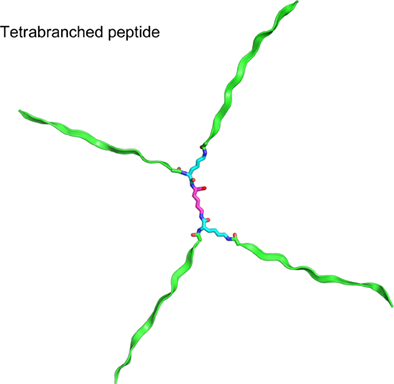 Tetrabranched peptide (Jlenia Brunetti, et al. 2018)
| Peptide sequence | Activity | Properties |
|---|---|---|
| (KKIRVRLSA)4K2K-βala | Antimicrobial peptide | Activity against different multidrug resistant Gram-negative bacteria; anti-inflammatory effects in vitro and in vivo |
| (KACRKK)2*KLKBBAY | Antimicrobial peptide | Activity against C. albicans, S. aureus, and E. coli |
| (KL)8(KKL)4(KKL)2KKL | Antimicrobial peptide | In vitro activity against several Gram-negative strains |
| (pyELYENKPRRPYIL)4K2K-βala | Antitumor activity | Cancer-selective targeting agents in vitro, ex vivo, and in vivo |
| (KCCYSL)NH2 | Antitumor activity of liposomes decorated with P6.1 peptide | Activity as target-selective delivery system to cancer cells overexpressing human epidermal growth factor receptor-2 |
| Reducible branched cationic polypeptide (RBCP) | Antitumor activity of a dual sensitive branched codelivery system RHD/p53 | In vitro and in vivo studies indicated that the system RHD/p53 could enhance antitumor efficacy, which provides a useful strategy for co-delivery of different therapeutic agents in tumor treatment |
Drug development: Branched peptides can provide enhanced stability, solubility, and bioavailability compared to linear peptides, which can improve their therapeutic potential. They can also be designed to target specific receptors or enzymes, making them useful for the development of targeted therapies.
Vaccine development: By presenting multiple copies of an antigen on a branched peptide, it is possible to stimulate a stronger immune response than with a linear peptide.
Biomaterials: For example, branched peptides can self-assemble into nanofibers, which can be used as scaffolds for tissue engineering or drug delivery.
Diagnostics: Used as probes for imaging or diagnostic purposes. By attaching a fluorescent or radioactive label to a branched peptide, it is possible to visualize specific targets in vivo or in vitro.
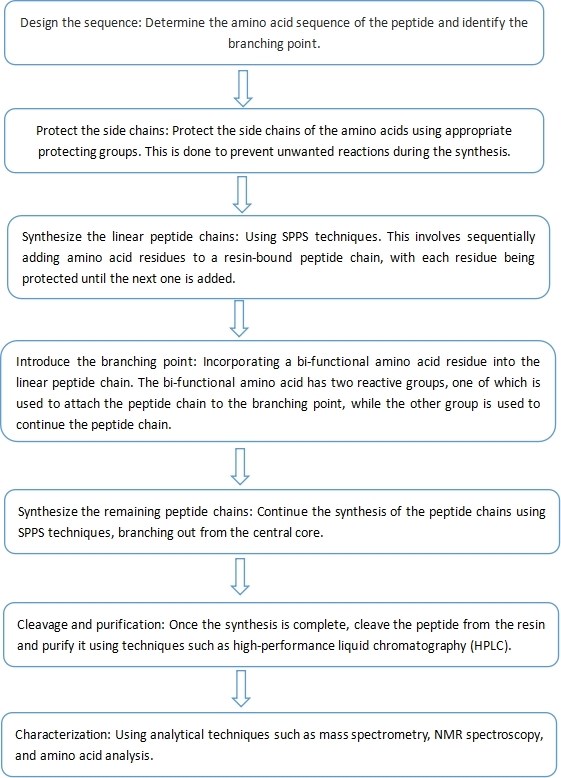
We have long-term peptide synthesis experience and rich expertise. Please contact us at the department of custom services when you intend to modify your peptide by branching.
A branched peptide consists of multiple peptide chains linked to a central core or scaffold. This multivalent structure distinguishes it from linear peptides and enables enhanced functional properties.
The bulkier, multivalent structure increases resistance to proteases and peptidases. This enhanced stability contributes to longer experimental or in vivo half-life.
Branched peptides are often built on lysine backbones, dendrimers, or conjugated to carrier proteins like BSA, KLH, or OVA. Each design allows customization for specific binding or functional requirements.
Multivalent interactions increase binding strength to targets compared to linear peptides. Branched peptides can serve as scaffolds for receptor targeting or selective ligand presentation.
Yes, displaying multiple antigen copies on a branched peptide can amplify immune activation. This feature is useful for designing peptide-based vaccine constructs or immunological probes.
Branched peptides can self-assemble into nanofibers or hydrogels. These structures are employed as scaffolds in tissue engineering or for controlled delivery of molecules.
Yes, branched peptides can be labeled with fluorescent or radioactive tags. They serve as probes to visualize targets in vitro or in vivo with enhanced sensitivity.

