Site-Selective ConjugationLinker-Payload OptimizationPeptide FunctionalizationResearch-Grade QC
At Creative Peptides, we provide custom peptide-small-molecule conjugation services for discovery, assay development, and non-clinical research programs that require precise attachment chemistry, reliable purification, and clear analytical confirmation. Our team supports the design and preparation of peptide conjugates with fluorophores, affinity tags, inhibitors, lipophilic motifs, cofactors, and other functional small molecules using sequence-aware modification and fit-for-purpose conjugation workflows. By integrating peptide modification services, custom conjugation service capabilities, and practical analytical support, we help biotech, pharma, and research teams move from peptide design to well-characterized conjugates with fewer development bottlenecks.
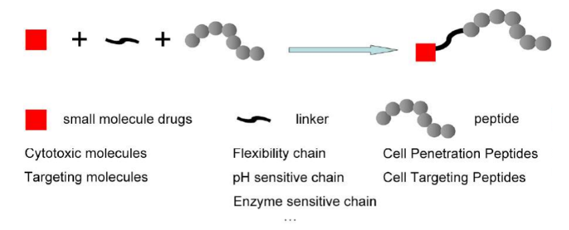
Many peptide programs reach a stage where the native sequence alone is not enough for the next experiment or decision point. A peptide may bind well, but still lack a practical way to generate signal, attach a probe, carry a functional small molecule, or maintain acceptable behavior after modification. Peptide-small-molecule conjugation addresses these real development gaps by turning a peptide into a more useful research and evaluation tool.
This technology is often used to solve challenges such as:
We offer flexible peptide-small-molecule conjugation workflows for clients who need technically feasible chemistry, interpretable data, and project-specific delivery. Projects can start from a new peptide design, a client-supplied sequence, or an existing modified peptide intermediate, and can be expanded with linkers and spacers, orthogonal handles, or follow-on optimization where needed.
Effective peptide-small-molecule conjugation starts with a practical review of the peptide sequence, the small-molecule structure, and the intended project goal. Our scientists evaluate reactive groups, steric burden, linker needs, and likely analytical challenges before selecting a c
This front-end evaluation helps reduce route changes later in the project and supports cleaner decision-making before synthesis begins.
We prepare peptide intermediates that are designed for controlled coupling to small molecules, including sequences that require selective protection, preinstalled handles, or specific terminal formats. Where needed, our team also supports peptide linker design to improve coupling practicality and downstream performance.
We focus on precursor design that simplifies the conjugation step while maintaining peptide integrity and manageable purification.
The core of the project is the controlled assembly of the peptide and the small-molecule component. We support conjugation routes selected for substrate compatibility, desired stability, and project-specific functional needs.
These services are suited to projects that require controlled coupling rather than broad, non-specific modification.
In many peptide-small-molecule conjugates, the linker is not just a connector. It can directly affect conversion, solubility, steric accessibility, and whether the small molecule remains attached or is intended to separate under defined conditions.
We help clients avoid conjugates that are chemically possible but operationally difficult to purify, characterize, or use.
Peptide-small-molecule conjugates often require more than routine purity measurement. We provide analytical review tailored to coupling confirmation, by-product control, and the practical questions that matter before a conjugate moves into screening or assay workflows.
Some clients need more than a single conjugate. We can build small panels of peptide-small-molecule constructs to support comparison across attachment sites, linker types, and payload formats.
The right conjugation route depends on the peptide sequence, the available functional groups on the small molecule, the need for site control, and how the final conjugate will be used. The table below summarizes common technical routes and their practical development considerations.
| Conjugation Strategy | Typical Attachment Logic | Suitable Payload Type | Typical Research Use | Key Consideration |
|---|---|---|---|---|
| Amide Bond Formation | Coupling through amine and carboxyl groups on peptide or payload | Small molecules with carboxyl, amine, or activated ester functionality | Stable probe construction, inhibitor conjugates, affinity-tagged constructs | Competing reactive groups may require selective protection or handle installation |
| Thiol-Based Conjugation | Coupling through Cys or thiol-bearing linker handles | Maleimide, haloacetyl, disulfide-ready, or thiol-reactive payloads | Defined site attachment, linker screening, rapid conjugate assembly | Thiol oxidation and exchange behavior should be controlled during processing |
| Azide-Alkyne Click Conjugation | Bioorthogonal coupling after installing azide or alkyne on one partner | Dyes, probes, affinity tags, hydrophobic motifs, diverse functional payloads | Clean assembly of research conjugates with reduced off-pathway reactivity | Handle placement and spacer length strongly affect steric accessibility |
| Oxime or Hydrazone Ligation | Coupling of carbonyl-bearing substrates with aminooxy or hydrazide handles | Aldehyde- or ketone-containing payloads and derivatized peptides | Controlled labeling, linker-enabled assembly, reversible or condition-sensitive designs | Bond stability should be matched to storage and assay conditions |
| Direct Linker-Assisted Attachment | Spacer introduced between peptide and small molecule to improve function | Hydrophobic, bulky, or sterically demanding small molecules | Solubility balancing, steric relief, assay-readiness improvement | Linker polarity and length can change both purification behavior and readout quality |
| Cleavable Conjugation Design | Payload attached through a bond or spacer intended to break under defined conditions | Functional small molecules requiring conditional separation | Mechanism studies, release evaluation, responsive construct design | Release behavior must be verified under project-relevant conditions |
Successful peptide-small-molecule conjugation depends not only on whether coupling is chemically feasible, but also on how each design choice affects conjugate quality, usability, and downstream study performance. The table below outlines the main factors that typically influence route selection, purification strategy, analytical confirmation, and overall project success.
| Design Factor | Why It Matters | Common Options or Variables | Potential Impact on the Conjugate |
|---|---|---|---|
| Attachment Site on the Peptide | The conjugation position can influence peptide recognition, steric accessibility, and product homogeneity. | N-terminus, C-terminus, Lys side chain, Cys residue, Asp/Glu side chain, or an introduced orthogonal handle | Can affect biological relevance, coupling selectivity, structural interpretation, and risk of heterogeneous products. |
| Reactive Group Compatibility | The peptide and the small molecule must contain or be modified to contain mutually compatible functional groups for controlled coupling. | Amine-carboxyl, thiol-maleimide, azide-alkyne, aminooxy-carbonyl, hydrazide-carbonyl, activated ester systems | Determines whether conjugation is practical, selective, and efficient under manageable reaction conditions. |
| Linker Length and Flexibility | A linker can reduce steric hindrance and improve the spatial presentation of the peptide or payload. | Direct attachment, short spacer, PEG-like linker, alkyl linker, rigid spacer, flexible spacer | Influences coupling accessibility, target interaction, assay performance, and purification behavior. |
| Linker Polarity and Solubility Contribution | The physicochemical profile of the linker can help compensate for hydrophobic payloads or, in some cases, worsen handling properties. | Hydrophilic spacer, neutral spacer, hydrophobic linker, mixed-polarity architecture | Can improve or reduce solubility, aggregation tendency, recovery, and chromatographic separation. |
| Payload Size and Steric Demand | Bulky small molecules may interfere with coupling efficiency or alter how the peptide behaves after modification. | Compact tag, medium-sized probe, bulky fluorophore, hydrophobic motif, inhibitor-like payload | May reduce conversion, increase purification difficulty, or require linker-assisted design to maintain usability. |
| Bond Stability | Different projects require either stable attachment or condition-responsive release behavior. | Non-cleavable bond, reducible linkage, acid-sensitive bond, reversible ligation, condition-sensitive spacer | Affects storage behavior, assay reliability, and whether the conjugate remains intact during downstream use. |
| Peptide Sequence Complexity | Certain sequences are more prone to side reactions, aggregation, oxidation, or challenging purification during modification. | Multiple Lys or Cys residues, highly hydrophobic segments, aggregation-prone motifs, sensitive side chains | May require selective protection, route redesign, alternative attachment sites, or more careful purification planning. |
| Small-Molecule Stability During Coupling | Some small molecules do not tolerate strong reagents, prolonged reaction times, or certain solvent systems. | Base-sensitive payloads, oxidation-sensitive motifs, light-sensitive labels, hydrolysis-prone derivatives | Can limit chemistry choice and require milder conjugation conditions or staged assembly strategies. |
| Purification Difficulty | Peptide-small-molecule conjugates often have polarity and retention properties that differ substantially from the starting peptide. | Easy-to-separate systems, closely eluting by-products, hydrophobic conjugates, multiple side-product profiles | Influences achievable purity, material recovery, process efficiency, and final batch usability. |
| Analytical Confirmation Requirements | Clear confirmation is essential when small mass shifts, isomeric by-products, or incomplete conversion could complicate interpretation. | HPLC purity, LC-MS mass confirmation, MALDI-TOF, labeling-specific signal analysis, side-product review | Determines how confidently the final conjugate can be advanced into screening, assay development, or mechanism studies. |
Peptide-small-molecule conjugation can be used to introduce a wide range of functional payloads depending on the intended research purpose, analytical workflow, and construct design strategy. The table below outlines common categories of small molecules that can be conjugated to peptides, together with their typical roles and key development considerations.
| Small-Molecule Category | Typical Examples | Main Purpose in Peptide Conjugation | Key Development Consideration |
|---|---|---|---|
| Fluorescent Dyes | FITC, FAM, TAMRA, Cy3, Cy5, rhodamine derivatives | Used for visualization, localization studies, uptake tracking, binding assays, and signal generation. | Dye size, hydrophobicity, and labeling position can affect peptide behavior, signal quality, and purification difficulty. |
| Affinity Tags | Biotin, desthiobiotin, hapten-like labels | Used for pull-down, capture, enrichment, immobilization, and interaction analysis. | Spacer design is often important to reduce steric hindrance and improve accessibility in binding or capture systems. |
| Bioorthogonal Handles | Azide, alkyne, tetrazine-reactive motifs, strained alkynes | Enable secondary labeling, modular assembly, and selective downstream functionalization. | Handle placement and orthogonal compatibility should be planned carefully to avoid side reactions and maintain clean conjugation. |
| Small-Molecule Inhibitors | Kinase inhibitor-like motifs, enzyme-binding fragments, pathway-focused small molecules | Used to create hybrid constructs that combine peptide recognition with small-molecule functional activity. | The inhibitor structure may be sensitive to linker position, steric interference, or conjugation chemistry. |
| Lipophilic Moieties | Fatty acids, cholesterol-like groups, alkyl chains, aromatic hydrophobic motifs | Used to adjust membrane interaction, hydrophobic balance, or molecular presentation in research constructs. | These payloads often increase hydrophobicity and may complicate solubility, purification, and recovery. |
| Cofactors and Vitamins | Biotin-like cofactors, folate-related motifs, vitamin derivatives, redox-active small molecules | Used in functional probe design, interaction studies, and mechanism-oriented conjugate construction. | Functional integrity of the small molecule should be preserved during coupling and purification. |
| Chromophores and Quenchers | Dabcyl, BHQ derivatives, UV-active aromatic labels | Used for signal modulation, reporter systems, and assay formats based on fluorescence change or optical response. | The relative position between chromophore and peptide sequence can strongly influence readout performance. |
| Redox-Active or Reactive Probes | Photo-reactive groups, crosslinking fragments, redox-sensitive small molecules | Used for mechanism studies, covalent capture experiments, and condition-responsive probe design. | These payloads may require mild reaction conditions and careful control of light, oxidation, or reaction timing. |
| Solubility-Modifying Small Molecules | Hydrophilic tags, charged motifs, PEG-like small functional units | Used to improve handling, reduce aggregation tendency, or rebalance physicochemical properties of the conjugate. | Property-modifying groups should be selected with attention to their effect on purification, assay background, and overall construct profile. |
| Custom Functional Payloads | Client-defined probes, screening fragments, labeled ligands, research-use small-molecule tools | Used when a project requires a peptide linked to a highly specific functional molecule not covered by standard categories. | Feasibility depends on functional group availability, chemical stability, steric burden, and analytical tractability. |

Sequence- and Payload-Aware Planning
We review both the peptide and the small molecule before route selection, helping reduce avoidable incompatibilities in conjugation chemistry, linker choice, and purification.

Site-Selective Conjugation Focus
Our workflows prioritize defined attachment strategies that support cleaner products and more meaningful structure-property interpretation.

Flexible Linker Design Support
We help optimize spacer length, polarity, and bond type so the conjugate is not only synthetically accessible but also practical for downstream research use.

Integrated Peptide-to-Conjugate Workflow
From precursor synthesis to payload coupling and final purification, projects can be managed as a coordinated workflow instead of disconnected steps.

Research-Grade Analytical Depth
We combine chromatographic and mass-based characterization to confirm conjugation success, assess by-products, and support confident project progression.

Built for Real Project Iteration
When the first design needs adjustment, we can support alternative sites, revised linkers, or expanded analog sets to improve feasibility and data quality.
Our workflow is designed to move from feasibility assessment to delivery of well-characterized peptide-small-molecule conjugates that are ready for research and non-clinical use.
1
Project Review and Conjugation Goal Definition
2
Route Design and Attachment-Site Planning
3
Preparation of Peptide Precursors
4
Payload Coupling and Conjugate Assembly
5
Purification and Structural Confirmation
6
Delivery and Follow-On Optimization Support
Peptide-small-molecule conjugates are widely used in research workflows that need controlled functionalization, stronger assay utility, or a more informative way to study peptide behavior. Below are representative application areas where this service can add clear technical value.
Peptide-small-molecule conjugation involves linking peptides to small molecules like fluorophores, chelating agents, or therapeutic compounds. This method enhances the properties of peptides, such as penetration and specificity.
These conjugates offer high selectivity, low immunogenicity, and excellent biocompatibility. They enable targeted imaging, allowing real-time tumor localization and analysis.
These conjugates can be designed to target cancer cells specifically, enhancing therapeutic effects while reducing side effects. This approach improves drug delivery efficiency.
Peptides can be conjugated with small molecules like adrenergic agonists, mycotoxins, antibiotics, and steroid hormones. These molecules improve the peptide's functional capabilities.
Yes, they can be used for targeted research in epigenetics, offering precise targeting of specific proteins or cellular pathways involved in gene regulation.
These conjugates can be utilized in fluorescence imaging, photoacoustic imaging, MRI, and even radiation imaging. They enhance the resolution and accuracy of imaging technologies.

If your team needs a reliable partner for peptide-small-molecule conjugation, linker selection, payload coupling, or conjugate optimization, Creative Peptides can support your program with practical chemistry, strong analytical control, and responsive technical collaboration. We work with biotech, pharmaceutical, and research teams on custom conjugation projects aligned to discovery and non-clinical goals. Contact us today to discuss your peptide sequence, payload type, and project scope.
