At Creative Peptides, we specialize in custom peptide-oligonucleotide conjugation (POC) — a cutting-edge technique that integrates peptide synthesis and oligonucleotide modification to create multifunctional molecules with enhanced stability, delivery, and biological performance. Our expert chemists combine advanced solid-phase synthesis, precise linker design, and analytical validation to deliver high-quality conjugates tailored to your research or therapeutic needs. Whether you are developing antisense oligonucleotides, siRNA therapeutics, or peptide-based delivery systems, we provide reliable, scalable, and cost-effective POC solutions from design to production.
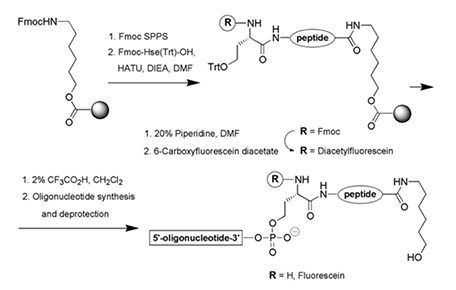 Fig.1 Total stepwise synthesis of oligonucleotide-(3-N)-peptide conjugates on a homoserine functionalized support (Stetsenko et al. 2005)
Traditional nucleic acid drugs often face challenges such as poor cellular uptake, limited tissue targeting, rapid degradation, and inefficient endosomal escape.
Peptide-oligonucleotide conjugation directly addresses these bottlenecks by:
We provide comprehensive, end-to-end peptide-oligonucleotide conjugation services designed to meet the stringent requirements of research, preclinical, and GMP manufacturing stages. Each service module is fully customizable and supported by expert chemists with extensive experience in peptide synthesis, oligonucleotide chemistry, and advanced bioconjugation techniques.
Every successful conjugation begins with thoughtful molecular design. Our scientists collaborate closely with you to define:
We then propose a complete technical roadmap, estimated yield, project timeline, and analytical plan — ensuring transparency from concept to delivery.
Our peptide synthesis platform utilizes solid-phase peptide synthesis (SPPS) with state-of-the-art automated synthesizers and controlled reaction monitoring.
Our peptide team ensures every batch meets high purity and identity standards, suitable for both research-grade and GMP manufacturing.
We synthesize DNA, RNA, ASO, siRNA, PNA, and aptamers with precise control over sequence fidelity, modification pattern, and scale.
Our oligo chemistry team ensures precise coupling efficiency and minimal depurination for highly stable conjugation substrates.
Using validated, site-specific chemistries, we perform controlled peptide–oligonucleotide conjugation under optimized conditions to maximize yield and maintain structural integrity.
All reactions are monitored in real time using analytical LC and UV profiles to ensure reproducibility.
Each conjugate undergoes comprehensive purification and analytical verification to ensure chemical purity, sequence accuracy, and biophysical stability.
We provide scalable synthesis solutions — from milligram-scale research batches to gram-scale GMP manufacturing suitable for IND-enabling studies.
Our manufacturing features:
To complement chemical conjugation, we offer biological evaluation and functional testing support through partner laboratories.
Available assays:
Selecting the right peptide is critical to achieving optimal delivery efficiency and biological performance. We offer a wide portfolio of custom and catalog peptides designed for different therapeutic and diagnostic goals.
| Peptide Type | Main Function | Common Sequences / Examples | Typical Applications | Key Advantages |
|---|---|---|---|---|
| Cell-Penetrating Peptides (CPPs) | Facilitate membrane translocation of oligonucleotides | TAT, Penetratin, R8, Transportan, Pep-1 | siRNA / ASO delivery, intracellular imaging | Enhance cellular uptake and endosomal escape |
| Targeting Peptides | Direct conjugates to specific cells or tissues | RGD, NGR, cRGDfK, Angiopep-2, MSH analogs | Tumor targeting, brain delivery, receptor-mediated uptake | Improve selectivity and tissue specificity |
| Endosomal Escape Peptides | Promote release of nucleic acids from endosomes | INF7, GALA, HA2, KALA | siRNA / mRNA delivery, endosome-sensitive systems | Increase cytosolic delivery efficiency |
| Nuclear Localization Peptides (NLS) | Transport conjugates into the nucleus | PKKKRKV, SV40 NLS, M9 | Gene regulation, antisense therapy | Enhance nuclear access and transcriptional control |
| Mitochondrial Targeting Peptides | Direct oligonucleotides to mitochondria | MTS (COX8a) | Mitochondrial disease research, RNA therapeutics | Enable organelle-specific targeting |
| Cleavable / Responsive Peptides | Release oligonucleotide under specific conditions | Enzyme-cleavable linkers, acid-labile motifs | Controlled release in tumor microenvironment | Tunable release and improved safety |
| Custom Peptides | Tailor-made sequences for novel delivery systems | Designed per project need | Any nucleic acid platform (ASO, siRNA, PNA, Aptamer) | Fully customizable to meet project objectives |
Our peptide–oligonucleotide conjugation platform supports a wide range of nucleic acid molecules used across drug discovery, diagnostics, and therapeutic delivery. Each molecule type has unique structural and functional features that influence conjugation chemistry, linker design, and peptide selection.
| Molecule Type | Full Name / Description | Typical Modifications | Applications | Conjugation Advantages |
|---|---|---|---|---|
| ASO | Antisense Oligonucleotide – short single-stranded DNA or RNA designed to modulate gene expression | Phosphorothioate (PS) backbone, 2'-O-methyl, 2'-MOE, LNAs | Gene silencing, splice modulation, RNA knockdown | Improves stability and tissue uptake via peptide conjugation |
| siRNA | Small Interfering RNA – double-stranded RNA molecules (typically 21–23 nt) that trigger RNA interference | 2'-O-methyl, 2'-F, phosphorothioate ends, blunt or overhang design | Gene knockdown, therapeutic RNAi | Enhances cell penetration, endosomal escape, and in vivo delivery |
| PNA | Peptide Nucleic Acid – synthetic analog with peptide-like backbone | N-terminal labeling, lysine or cysteine handles, fluorescent tags | Antisense inhibition, molecular probes, diagnostics | High binding affinity and chemical stability; easy conjugation with peptides |
| Aptamer | Single-stranded DNA/RNA that folds into 3D structure for target binding | Biotin, amine, thiol, azide handles, PEGylation | Targeted delivery, biomarker detection, therapeutic blocking | Peptide conjugation adds targeting or extended circulation |
| mRNA / saRNA | Messenger or self-amplifying RNA for protein expression | Cap analogs, modified nucleotides (Ψ, m5C), 5'/3' UTR engineering | Vaccines, protein replacement therapies | Peptide fusion or conjugation improves translation and cellular entry |
| DNA Probes / Oligos | Custom DNA sequences for hybridization, labeling, or detection | Fluorescent tags, spacers, linkers, biotin | Molecular diagnostics, imaging, biosensing | Enables controlled immobilization and multiplex detection |

Precision Chemistry
Site-specific conjugation ensures consistent molecular orientation and reproducible bioactivity.

Broad Molecule Compatibilit
Fully compatible with ASO, siRNA, PNA, aptamer, and mRNA platforms.

Diverse Peptide Options
Access to a wide catalog of cell-penetrating, targeting, and endosomal escape peptides for customizable delivery.

Enhanced Delivery Efficiency
Peptide conjugation significantly improves cell uptake, tissue targeting, and endosomal release of oligonucleotides.

Improved Stability
Chemical conjugation protects nucleic acids from enzymatic degradation and extends in-vivo half-life.

Flexible Scale & GMP Support
From discovery to clinical manufacturing, scalable production with full documentation and regulatory compliance.

Comprehensive Analytical Support
Every batch is verified by LC-MS, HPLC, and functional testing to meet stringent purity and identity standards.

Fast Turnaround & Technical Expertise
Expert chemists with extensive peptide and oligonucleotide synthesis experience deliver reliable results on schedule.

One-Stop Solution
Integrated design, synthesis, conjugation, and characterization services eliminate multi-vendor coordination.
Our streamlined workflow ensures precision, traceability, and reproducibility at every stage of your project — from concept to final conjugate delivery.
1
Project Consultation & Design Planning
2
Peptide & Oligonucleotide Synthesis
3
Conjugation & Optimization
4
Purification & Analytical Characterization
5
Scale-Up, Documentation & Delivery
Peptide-oligonucleotide conjugation (POC) technology has broad utility across therapeutics, diagnostics, and biotechnology research. Below are the major application areas and how this technology is applied in each:
Ready to take your nucleic acid research to the next level? Partner with Creative Peptides, a global provider of custom peptide-oligonucleotide conjugation, bioconjugation chemistry, and delivery optimization solutions. From design to GMP manufacturing, our experts deliver precision-engineered conjugates tailored to your therapeutic or diagnostic goals. Contact us today to discuss your project or request a free consultation and quotation.
We support DNA, RNA, ASO, siRNA, PNA, aptamers, and mRNA with multiple chemical backbones (PS, 2'-O-Me, 2'-F, LNA, etc.).
We use click chemistry (CuAAC/SPAAC), thiol-maleimide, disulfide exchange, EDC/NHS amidation, and other site-specific linkers depending on the molecular handles.
Yes. Our platform supports research-scale and GMP-compliant manufacturing with full documentation, traceability, and CoA.
Each conjugate is analyzed by LC-MS, HPLC/UPLC, UV-Vis spectroscopy, and stability testing to confirm purity, identity, and integrity.
Absolutely. Our scientists can assist in sequence design, selection of conjugation sites, and optimization of physicochemical properties to meet your biological objectives.

