At Creative Peptides, we have been designing, synthesizing and applying peptide library technology for many years. We provide overlapping peptide library services that will be tailored to specific research issues.
The design of overlapping peptide library is mainly used for whole protein scanning. The head-to-tail peptide matrix is a common method for screening linear or continuous epitopes. The design of this peptide library is mainly determined by two key parameters, peptide length and offset number. The design is gradually intercepted from the N-terminal to C-terminal of the target protein, there is likely to be a orphan peptide. We generally transfer one or more amino acids from the N-terminal to maintain the same length.
Choosing the appropriate step and peptide length can reduce the experimental cost and maximize the value of the data. The step is usually designed as a third of the peptide length. Long peptides contain more epitopes, but such peptides are generally difficult to synthesize and contain fewer peptides in the library. Short peptides are easier to synthesize and cheaper, but have fewer epitopes per peptide.
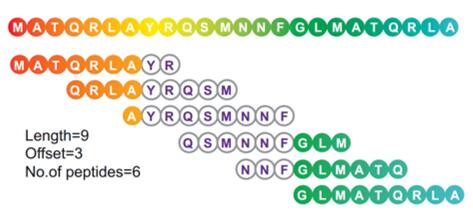
Creative Peptides's overlapping peptide library can be designed according to customers' requirements and future experimental purposes, and provide personal services such as peptide library design consultation and peptide library design guidance according to customers' practical problems.
An overlapping peptide library is primarily used for scanning whole proteins, identifying antigenic peptide sequences, screening enzyme substrates, identifying T cell epitopes, and pinpointing localized antibody epitopes.
It is designed by systematically cutting the target protein from the N-terminal to C-terminal, with peptides overlapping by a set number of amino acids. This method helps to maximize the chances of identifying continuous epitopes.
Using this method, researchers can efficiently identify important peptide sequences and binding sites, offering high flexibility for different research needs while reducing experimental costs.
The purity of crude peptides is typically more than 30%, but purified peptides can reach >70%, >80%, or even >98%, depending on customer needs.
Applications include identifying binding sites of target proteins, screening for T cell epitopes, detecting localized antibody epitopes, and enzyme substrate screening.
Yes, Creative Peptides offers custom overlapping peptide libraries in a variety of sizes and formats, from small sets of peptides to large libraries of thousands of species.
Each peptide is synthesized in an independent channel to prevent cross-contamination, and we provide HPLC purification and MS test reports to ensure quality.

References
