Our global business capability is designed to provide you with the highest quality locked nucleic acid oligonucleotides prepared according to your exact specifications. With many years of oligonucleotide synthesis expertise, Creative Peptides is proud of our cooperation with you from early research to commercial launch.
Locked nucleic acid is a kind of RNA analogues based on non-deoxyribose, in which the 2'-O on the ribosome ring is connected to 4'-C, so that the five-membered ring is "locked" in the ideal Watson-Crick three-dimensional binding conformation. Therefore, Locked nucleic acid obeys stronger base complementary pairing, greater base accumulation force and better hybrid stability, and will not be recognized and degraded by nuclease in tissue cells. When a locked nucleic acid monomer is added to the nucleic acid chain, the temperature (TM) value of the double-stranded hybrid can be increased by 2-8℃. Locked nucleic acid increases the differentiation of base mismatch, which can distinguish the difference of single base, and can make the oligos containing locked nucleic acid maintain a high TM value at a shorter length.
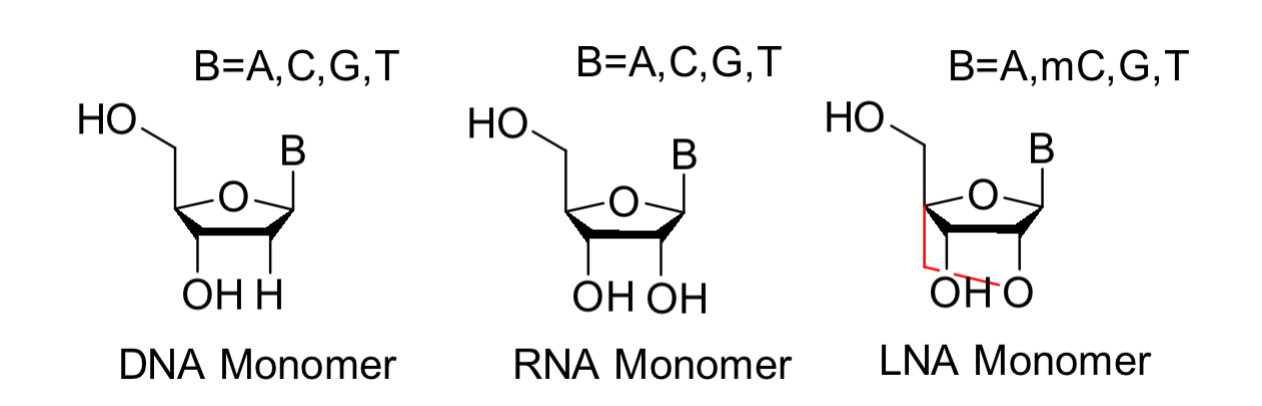
LNA offers high stability both in vivo and in vitro, excellent mismatch discrimination, and superior hybridization specificity. It enhances the sensitivity and specificity of assays, especially in challenging samples, such as biofluids and FFPE samples.
LNA significantly improves mismatch discrimination in SNP genotyping assays, allowing for more accurate identification of alleles by increasing the thermal stability and hybridization efficiency of probes.
Yes, LNA-based oligonucleotides are highly effective for gene expression analysis due to their improved ability to hybridize with RNA and DNA, offering better sensitivity and specificity for detecting low-abundance targets.
LNA is widely used in SNP detection, allele identification, gene copy assays, pathogen detection, and miRNA analysis. Its high stability and sensitivity make it ideal for quantitative assessments in complex samples.
The "locked" structure of LNA stabilizes the hybridization between RNA and DNA, improving thermal stability and making LNA a powerful tool for designing probes with higher binding affinity and specificity.
LNA sequences can be customized with various modifications, such as phosphorylation, thiolation, modified bases, and linkages, to meet the specific needs of your experiments, enhancing the flexibility of probe design.
LNA oligonucleotides increase the sensitivity and specificity of quantitative PCR (qPCR) assays, allowing for more reliable detection of low-concentration targets and enabling precise quantification in complex mixtures.
Every LNA sequence is dual-HPLC purified and MS verified, ensuring high-quality, reliable results for your research. This rigorous quality control guarantees that the final product meets your exact specifications.

References
