DOTAGA Peptide SynthesisChelator Peptide DesignMetal-Free PrecursorsSPPS Conjugation
At Creative Peptides, we provide custom DOTAGA chelating peptide synthesis services for discovery, radiochemistry, and molecular imaging research teams that need a defined metal-binding peptide precursor with dependable synthesis and analytical control. Our team supports de novo sequence preparation, late-stage DOTAGA conjugation, spacer engineering, and purification of metal-free DOTAGA peptide constructs for downstream radiometal coordination studies. By combining custom peptide synthesis, peptide modification services, and peptides-metal chelates conjugation, we help biotech, pharma, CRO, and academic groups move from sequence concept to research-ready DOTAGA peptide candidates.
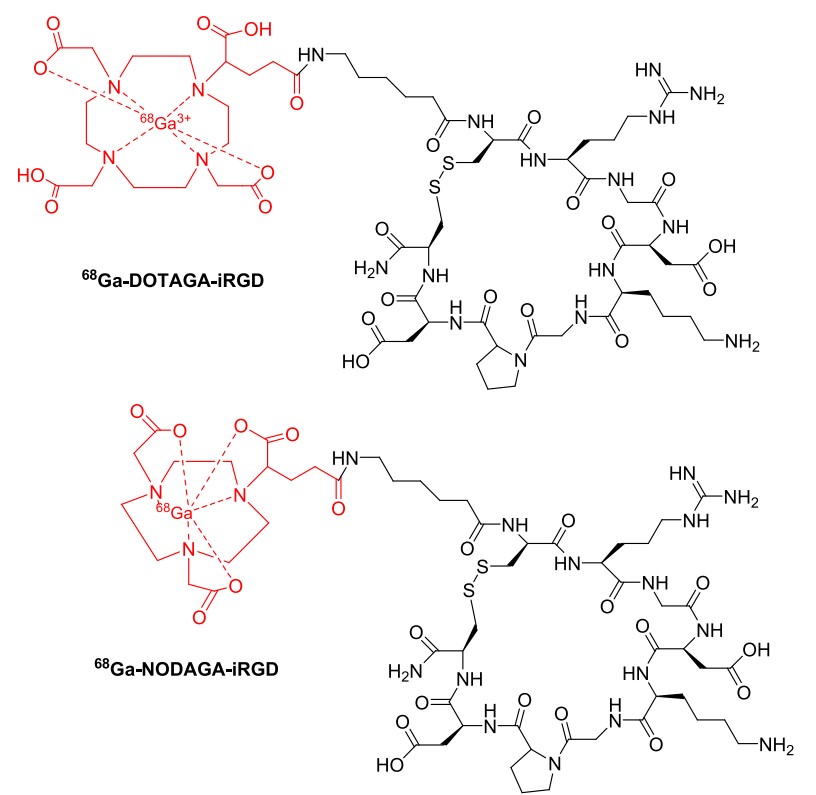 Schematic representation of structures of 68Ga-DiRGD and 68Ga-NiRGD. (Satpati, D., 2020)
DOTAGA is a DOTA-derived macrocyclic chelator often selected when a peptide project needs a robust metal-binding unit together with a charge profile that can influence solubility, biodistribution-related behavior, and later radiometal coordination studies. In practice, however, converting a peptide into a useful DOTAGA precursor is rarely a simple one-step modification.
Many projects run into sequence-specific problems: the N-terminus may contribute to target recognition, multiple Lys residues can create heterogeneous conjugation, hydrophobic binders may become harder to dissolve and purify after chelator installation, and cyclic or disulfide-containing peptides often require a carefully planned order of cyclization, deprotection, and DOTAGA coupling.
DOTAGA chelating peptide synthesis helps address these issues by:
 Schematic overview of DOTAGA chelating peptide synthesis, including site selection, protected chelator incorporation, spacer design, purification, and metal-free analytical confirmation
We provide flexible DOTAGA peptide workflows for teams developing targeting ligands, radiometal-binding peptide precursors, assay probes, and constrained peptide constructs. Projects can start from a new sequence, a client-supplied peptide, or a previously validated lead that now requires DOTAGA installation, linker optimization, or cleaner analytical characterization. When needed, our DOTAGA service can be coordinated with custom conjugation service support, linkers and spacers design, and downstream analytical review.
Effective DOTAGA peptide synthesis starts with a sequence-aware planning step rather than a generic chelator attachment workflow. We review the peptide sequence, intended target class, preferred attachment site, and expected downstream metal study requirements before selecting the synthetic route.
This front-end design step helps reduce rework and gives customers a clearer path to a useful DOTAGA peptide format.
For de novo sequences, our team builds DOTAGA peptide precursors using solid-phase peptide synthesis strategies selected for the sequence length, residue composition, and desired chelator position.
We focus on route designs that preserve sequence fidelity while keeping DOTAGA installation practical at the synthetic stage.
DOTAGA can be introduced by different strategies depending on whether the peptide is being built from scratch or provided as a finished intermediate. We support both protected DOTAGA incorporation and post-synthetic coupling workflows for research-ready peptide conjugates.
This service is especially useful when teams need a clean DOTAGA peptide precursor rather than a loosely defined chelator-peptide mixture.
In many DOTAGA projects, the chelator itself is not the only design variable. Spacer length, linker polarity, and attachment geometry can determine whether a conjugate remains easy to analyze and whether the peptide still performs as expected in binding or uptake studies.
Our linker decisions are guided by practical project questions, not generic decoration of the peptide sequence.
DOTAGA installation becomes more complex when the project involves cyclic peptides, disulfide-rich sequences, or peptides that must maintain a constrained conformation. We support route planning for these more demanding formats.
This helps reduce the risk of obtaining a chelated peptide that no longer matches the intended scaffold behavior.
DOTAGA-modified peptides often demand more than routine purity testing because the added chelator changes charge state, retention behavior, and the risk of metal adduct formation. We provide purification and analytical support designed for these realities.
Our goal is to provide a DOTAGA peptide batch that is interpretable, traceable, and ready for the next stage of non-clinical work.
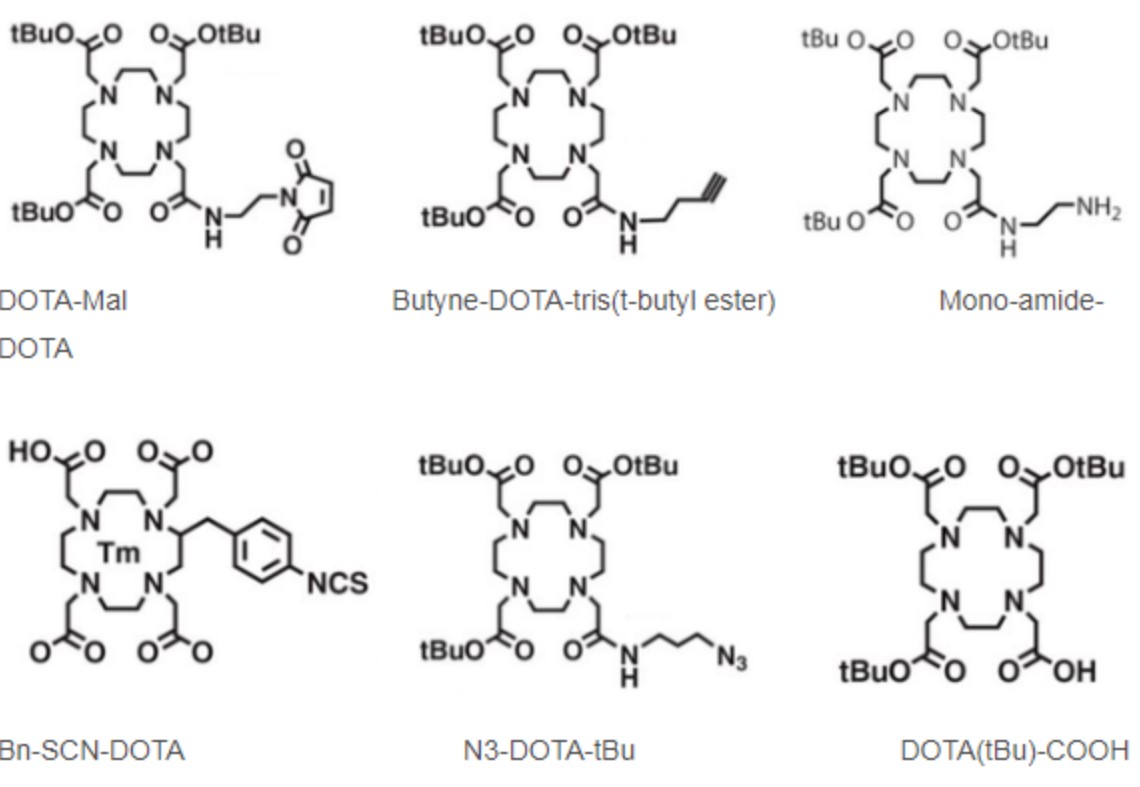 Other common DOTA chelating agents.
The most suitable DOTAGA peptide route depends on the sequence architecture, the required attachment position, and whether the peptide will be synthesized from scratch or modified after purification. The table below summarizes common DOTAGA incorporation formats and the practical logic behind each option.
| Synthesis Format | Typical DOTAGA Form | Best Suited Project | Main Benefit | Key Consideration |
|---|---|---|---|---|
| N-Terminal On-Resin Coupling | Protected DOTAGA derivative introduced during peptide assembly | New peptide sequences where the N-terminus is available for chelator installation | Streamlined build with defined attachment site and coordinated global deprotection | The N-terminus must not be essential for target recognition or assay function |
| Lys Side-Chain Route | Orthogonally protected Lys or related residue with controlled DOTAGA coupling | Peptides that need a free N-terminus or a more distal chelator position | Better preservation of the main binding motif with defined site control | Selective deprotection and side-chain accessibility must be planned carefully |
| Post-Synthesis Conjugation | Activated DOTAGA form such as DOTAGA-anhydride | Client-supplied peptides or validated leads requiring late-stage DOTAGA installation | Flexible entry point without rebuilding the full sequence | Multiple free amines can create heterogeneous products if selectivity is not controlled |
| Spacer-Assisted Design | DOTAGA attached through Ahx, PEG-like, or amino acid spacer elements | Sterically sensitive ligands and peptides with chelator-proximal binding motifs | Better separation between the chelator and the peptide pharmacophore | Spacer choice changes polarity, solubility, and HPLC retention behavior |
| Cyclic / Disulfide Workflow | Sequence-dependent combination of protected DOTAGA incorporation and late-stage processing | Constrained peptides that require controlled order of cyclization and chelator installation | Preserves ring architecture when the route is planned correctly | Cyclization, oxidation, and DOTAGA chemistry must be coordinated rather than treated separately |
DOTAGA peptide projects are usually driven by a specific technical question rather than by synthesis alone. The table below links common customer goals to the design choices, controls, and deliverables that matter most during DOTAGA chelating peptide development.
| Project Objective | Practical Question | Recommended Service Action | Typical Readouts | Customer Deliverable |
|---|---|---|---|---|
| Preserve Binding Motif | Will DOTAGA at the N-terminus or a Lys side chain interfere with peptide recognition? | Compare alternate attachment positions and, when needed, short spacer variants | LC-MS identity, HPLC profile, matched analog panel review | Prioritized DOTAGA placement strategy |
| Improve Handling | Does the DOTAGA-conjugated sequence become difficult to dissolve, recover, or analyze? | Adjust spacer polarity, salt form, and purification route to improve batch behavior | Recovery observations, chromatographic performance, appearance in working solvents | Better-handling DOTAGA peptide format |
| Support Later Metal Studies | Is a clean metal-free precursor needed for downstream radiometal coordination research? | Apply trace-metal-aware purification, handling, and storage planning | Identity confirmation, purity review, storage and handling recommendations | Metal-free DOTAGA peptide batch |
| Reduce Heterogeneity | Does the sequence contain multiple accessible amines or competing reactive groups? | Use orthogonal protection or selective late-stage coupling rather than uncontrolled bulk conjugation | Impurity profile, major product assessment, side-product review | Cleaner conjugate composition |
| Enable Constrained Formats | Should DOTAGA be installed before or after cyclization or disulfide formation? | Plan sequence-specific order of operations and protect sensitive residues during processing | Cyclization confirmation, LC-MS, analytical HPLC, comparative intermediate checks | Ring-intact DOTAGA peptide construct |
| Compare Design Variants | Do you need attachment-site, spacer, or comparator-chelator benchmarking? | Prepare a matched analog set for side-by-side evaluation | Comparative analytical package and batch-level documentation | Decision-ready DOTAGA analog panel |

Chelator-Aware Design
We evaluate attachment site, sequence sensitivity, and downstream metal-study needs before proposing a DOTAGA route.

Flexible Attachment Routes
Our team supports both de novo peptide assembly and late-stage DOTAGA conjugation for client-supplied sequences.

Orthogonal Control
We use selective protection and route planning to reduce heterogeneous conjugation when multiple reactive groups are present.

Difficult Sequence Support
Hydrophobic, cyclic, disulfide-rich, and sterically sensitive peptides are planned with sequence-specific synthesis logic.

Metal-Free Handling
Purification and batch handling are designed to deliver DOTAGA peptide precursors suitable for later coordination studies.

Actionable Analytics
We provide characterization that helps customers interpret coupling success, impurity risk, and project-readiness.
Our workflow is structured to move from technical review to delivery of a well-characterized DOTAGA peptide precursor that is suitable for downstream non-clinical research and radiochemistry work.
1
Sequence Review & Site Selection
2
Peptide Assembly Strategy
3
DOTAGA Installation
4
Purification & Characterization
5
Delivery & Optimization Support
DOTAGA-conjugated peptides are used across discovery and non-clinical programs where a stable chelator-peptide precursor is needed for metal coordination studies, targeting research, and assay development. Below are representative directions in which DOTAGA chelating peptide synthesis adds practical value.
DOTAGA chelating peptide synthesis involves the incorporation of the chelator DOTAGA (1,4,7,10-tetraazacyclododecane-1,4,7,10-tetraacetic acid) into peptides in order to facilitate the binding and visualization of radionuclides. This process is most commonly used in radiopharmaceuticals for diagnostic imaging and therapeutic purposes.
Our service can be utilized to produce a wide range of radiopharmaceuticals. The resulting products are often used in nuclear medicine for the diagnosis or treatment of various diseases, including different types of cancer.
The time taken for the DOTAGA chelation process may vary depending on the complexity of the peptide or protein to be chelated. However, our team of highly skilled professionals are dedicated to delivering the best results in a timely and efficient manner.
We have stringent quality control processes in place. These include HPLC analysis to verify the successful incorporation of DOTAGA into the peptide/protein and mass spectrometry to assess the integrity of the final product.
Yes, we provide customized solutions depending on the specific needs of the client. This includes assistance with peptide design, DOTAGA conjugation, purification, and quality control.

If your team needs a reliable partner for DOTAGA peptide synthesis, late-stage chelator conjugation, spacer optimization, or purification of metal-free peptide precursors, Creative Peptides can support your program with practical chemistry and decision-oriented analytics. We work with biotech, pharmaceutical, academic, and CRO teams on custom DOTAGA chelating peptide projects aligned to discovery and non-clinical goals. Contact us today to discuss your sequence, preferred attachment strategy, and project scope.
